


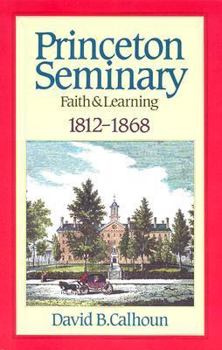
Princeton Seminary Faith and Learning 1812-1868


While the history of an institution, it is also a record of thought and action, trends and personalities. Backed by years of careful research, by his own long experience in the training of men for the... This description may be from another edition of this product.
Format:Library Binding
Language:English
ISBN:085151670X
ISBN13:9780851516707
Release Date:May 1996
Publisher:Banner of Truth
Length:495 Pages
Weight:1.70 lbs.
Dimensions:1.4" x 5.8" x 8.8"
Customer Reviews
3 ratings
The Home Of The Brave
Published by Thriftbooks.com User , 17 years ago
Too many accommodations to modern scientific thought had caused a consensus of strong reaction from well-meaning and highly-respected Princeton theologians, none more so than the ageing Professor Charles Hodge. His was the battle specifically for the uniqueness of man and he engaged with Darwinism to defend the Bible's view of creation as opposed to evolution. Scientific development had to be subjected to revelation, if it was to be conducive to the Christian faith. Findings that conflicted with God's revealed design were to be forthrightly rejected on biblical grounds. 'We have had, of later years, no abler theologians than the Hodges, and we fear it will be many a day before we see their like...We value every morsel about the Princeton worthies; may their influence long endure. The modern school thinks us fools, but certainly we were taught by wise men...Finer minds than those of the Princeton tutors have seldom dwelt among the sons of men.' Charles Haddon Spurgeon, quoted on p 46 Whereas the Reformation had rightly saved Christian doctrine from the perversions of Roman Catholicism, Old Princeton had a long battle ahead for the preservation of the Bible as the God-sanctioned Word. The task would require exacting semantics and accomplished linguists to overturn the kinds of teachings cloaked in liberal theologies that threatened to eclipse Reformed theology, and which actually repudiated, contradicted, or compromised the central motifs of the Bible. Of equal importance were the autonomous radical claims borne in the minds of Darwin, Nietzsche and Voltaire. Rebuttals ensued and especially Continental developments foreign to American Reformed theology were identified and treated in scholarly defenses, whilst forging important alliances with individuals who had the capacity to further orthodox Christian confession was given a high premium. AA Hodge stated that 'since the gospel is not a disclosure of abstract moral or spiritual truths, but rather a series of objective facts constituting the stupendous history of redemption, miracles are appropriate and valuable evidences of God's revelation' - a timely offensive against anti-supernaturalism. 'Miracles in such connections are inevitable, and in the highest sense, congruous. Their absence would have been unaccountable.' p 71 But he would not believe in a sporadic miracle, the younger Hodge told his students. This conventional theism taught God's immanence through the miraculous at various times of redemptive history, but was also couched in the larger context in the doctrine of providence, bearing testimony to the influence of the Puritans. Old Princeton's singular history in showing the co-existence of textual criticism and inerrancy as conceivable and even possible, would be crucial to the survival of the church and faith amidst forebodings of scientific inventions and explorations, world wars and material prosperity; and offered an alternative to an ever-increasingly atheistic American culture
Scholarly, readable volume
Published by Thriftbooks.com User , 23 years ago
I am reviewing this book partly to offset the unfavorable, and I believe misapplied, review by William Lane Johnson. Mr. Johnson seems to review this volume unfavorably based upon the liberalism of modern Princeton, but his criticism is not rightly applicable to the history of the institution during the years that this volume covers. In this volume David B. Calhoun writesof the history of Princeton Seminary from its founding in 1812 to the year of 1868, a time in which the school was orthodox, Evangelical and scholarly. Mr. Calhoun's study is also both warm and scholarly. I purchased and read my copy in the spring of 2002. I am still searching for the second volume of the series, The Majestic Testimony 1869-1929. It was in 1929 thatthe most conservative faculty members withdrew from the seminary(founding Westminster Seminary) and that Princeton Seminary began a more distinctly liberal pattern. I am not a member of the Reformed-Presbyterian tradition that is exemplified in this volume, but I appreciate much about it and appreciate the scholarly, readable volume of history and biography that this volume presents.
Truly wonderful!
Published by Thriftbooks.com User , 24 years ago
This is a real labor of love. Dr. Calhoun did his Th.M. and Ph.D. at Princeton and spent much of the next 15 years writing this history. His mastery and passion for the subject really shows. He is a very fine historian. What is also obvious is his pastor's heart. He is not afraid to give expansive quotes form the Old Princetonians which will move your heart to glorify God. Honestly, one o fthe 5 or 10 bets books i have ever read.
Copyright © 2026 Thriftbooks.com Terms of Use
| Privacy Policy | Do Not
Sell/Share My Personal Information | Cookie Policy | Cookie Preferences | Accessibility Statement
ThriftBooks® and the ThriftBooks® logo are registered trademarks of Thrift Books Global, LLC
ThriftBooks® and the ThriftBooks® logo are registered trademarks of Thrift Books Global, LLC
