


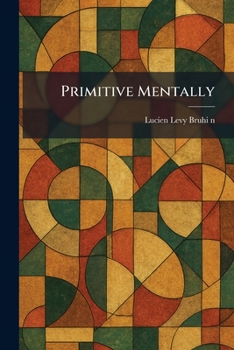
Primitive Mentally

"Primitive Mentally" is a foundational work in the field of social anthropology and cognitive sociology, exploring the distinctive ways in which members of traditional societies perceive and interact with the world. Written by the influential scholar Lucien Levy-Bruhl, this text challenges the prevailing assumptions of its era by positing that human cognition is not universally identical, but is instead profoundly shaped by social environments and collective representations.
Central to the work is the exploration of what Levy-Bruhl terms "pre-logical" thinking-a mindset that operates differently from the linear, scientific logic of the modern West. The author introduces the "law of participation," which suggests that in many cultures, there is a perceived mystical identity between individuals, objects, and the natural world that transcends physical boundaries. Through an analysis of ritual, myth, and social custom, "Primitive Mentally" examines how these belief systems function as coherent frameworks for understanding existence.
This study remains a significant milestone in the history of ideas, offering profound insights into the diversity of human thought and the sociological foundations of knowledge. It is a vital resource for readers interested in the evolution of psychological theory, historical anthropology, and the complex relationship between culture and the human mind.
This work has been selected by scholars as being culturally important, and is part of the knowledge base of civilization as we know it. This work was reproduced from the original artifact, and remains as true to the original work as possible. Therefore, you may see the original copyright references, library stamps (as most of these works have been housed in our most important libraries around the world), and other notations in the work.
This work is in the public domain in the United States of America, and possibly other nations. Within the United States, you may freely copy and distribute this work, as no entity (individual or corporate) has a copyright on the body of the work.
As a reproduction of a historical artifact, this work may contain missing or blurred pages, poor pictures, errant marks, etc. Scholars believe, and we concur, that this work is important enough to be preserved, reproduced, and made generally available to the public. We appreciate your support of the preservation process, and thank you for being an important part of keeping this knowledge alive and relevant.
Customer Reviews
ThriftBooks ® and the ThriftBooks ® logo are registered trademarks of Thrift Books Global, LLC
