


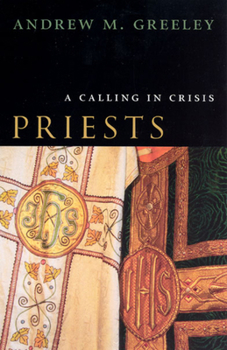
Priests: A Calling in Crisis


Select Format
Select Condition 
Book Overview
For several years now, the Roman Catholic Church and the institution of the priesthood itself have been at the center of a firestorm of controversy. While many of the criticisms lodged against the recent actions of the Church--and a small number of its priests--are justified, the majority of these criticisms are not. Hyperbolic and misleading coverage of recent scandals has created a public image of American priests that bears little relation to reality, and Andrew Greeley's Priests skewers this image with a systematic inside look at American priests today. No stranger to controversy himself, Greeley here challenges those analysts and the media who parrot them in placing the blame for recent Church scandals on the mandate of celibacy or a clerical culture that supports homosexuality. Drawing upon reliable national survey samples of priests, Greeley demolishes current stereotypes about the percentage of homosexual priests, the level of personal and professional happiness among priests, the role of celibacy in their lives, and many other issues. His findings are more than surprising: they reveal, among other things, that priests report higher levels of personal and professional satisfaction than doctors, lawyers, or faculty members; that they would overwhelmingly choose to become priests again; and that younger priests are far more conservative than their older brethren. While the picture Greeley paints should radically reorient the public perception of priests, he does not hesitate to criticize the Church's significant shortcomings. Most priests, for example, do not think the sexual abuse problems are serious, and they do not think that poor preaching or liturgy is a problem, though the laity give them very low marks on their ministerial skills. Priests do not listen to the laity, bishops do not listen to priests, and the Vatican does not listen to any of them. With Greeley's statistical evidence and provocative recommendations for change--including a national "Priest Corps" that would offer young men a limited term of service in the Church--Priests offers a new vision for American Catholics, one based on real problems and solutions rather than on images of a depraved, immature, and frustrated priesthood.
Format:Paperback
Language:English
ISBN:0226306453
ISBN13:9780226306452
Release Date:September 1994
Publisher:University of Chicago Press
Length:156 Pages
Weight:0.50 lbs.
Dimensions:0.4" x 6.0" x 8.7"
Customer Reviews
2 ratings
A real look at the Crisis of Priests
Published by Thriftbooks.com User , 20 years ago
Most books and articles I have read written about this subject have been very subjective and not based on any real samples. Here, Professor Greeley does a thorough analysis of the problems as seen from the religious and the laity point of views. An empirical studies if you will. And he includes Christian Pastors within this study. Though his research shows that most clergy are not in touch with the desires and complaints of their parishioners. The problems, including the sexual abuse scandal, do not appear to have their basis in celibacy nor in the sexual orientation of the clergy. They mainly seem to stem from the clergy not actually listening to their parishioners. For if they were, they may here what their flock feels it is missing. And then address these problems, whether they are real or just perceived. He also shows that the so-called celibacy issue is not a concern on why a Priest leaves his vocation. Nor does it have any impact on the scandal. He actually shows that most Priests are happy and well adjusted in their profession. The numbers come in right on par with the married Protestant Clergy. Priest leave the field for the same reason anyone else leaves theirs, they do not feel they are in the correct job and do not enjoy the duties. I agree with the author when he says, we should thank these mean for the time they shared with us and let them leave unhindered. For who would want a Pastor who does not wish to be there? And he feels the current crisis in the number of Priest has more to do with lack of recruitment. It seems that though most Priests are happy in their jobs and enjoy their work. They feel that their peers must be having a hard time coping with celibacy, even though they are not. So they do not want to recruit anyone into a job the recruit may find lonely. In my opinion this makes a self-fulfilling prophecy.
Well written, carefully argued book
Published by Thriftbooks.com User , 21 years ago
I should first say that this is the first and only book I've ever read by Greeley. Secondly I should say that I am not a sociologist, but I am university-educated (and currently in a doctoral program in theology). This is not only a very well written book (and therefore a pleasure to read), it is also a very methodologically sound sociological investigation of Roman Catholic priests in the U.S. The sort of banal assessment of the Roman Catholic priesthood reflected for example in the previous review of N. Ravitch ("Priests appear to be less educated, less intellectually curious, less conscientious, and less emphathetic than their parishioners have come to expect"; "all his [Greeley's] statistics don't really amount to a hill of beans"; "he [Greeley] underplays the role of celibacy in the sexual abuse scandal" etc.) are challenged by Greeley, who instead offers a picture shaped not by conventional wisdom, prejudice or anecdotal guesswork, but on studies interpreteted through a rigorous and critical sociological method. Greeley's data come from three sources: the study of an institute at the University of Chicago of which he was the head, and two Los Angeles Times studies. Each of these data sets are critically interpreted. For example, the first study was conducted in the 1970s and so it's not presumed that it necessarily reflects the current situation of American priests. The two LA Times studies were conducted around the time the sexual abuse scandals broke and shortly thereafter, and although Greeley says that by the inclusion of several thousand priests (both religious and diocesan, and from geographically diverse areas) the Times did far better than any other current studies, he himself would have wanted a larger sample. Nevertheless, these studies are not fundamentally flawed, and Greeley is very willing to work within imaginable margins of error so as not to skew the conclusions. Among the most interesting contributions made in this book are the careful assessment of the percentage of homosexual priests, the discussion of the level of happiness among priests with their chosen profession, and the implications of celibacy for priests (i.e. the myths that clerical celibacy has something to do with why men leave the priesthood or with the sexual abuse by some priests). The only reason I give the book four and not five stars is that at the very end, after his outstanding sociological study, Greeley moves briefly into the realm of theology. I found myself less satisfied with some of his suggestions in this portion of the book. I would certainly not say that Greeley "should stick to writing novels" -- though I might say that instead of including this final bit in which he records his theological musings, he might have done better to have "stuck to sociology" -- a field in which this book shows him to be an exceedingly competent practitioner.
Copyright © 2026 Thriftbooks.com
Terms of Use | Privacy Policy | Do Not Sell/Share My Personal Information | Cookie Notice | Cookie Preferences | Accessibility Statement
ThriftBooks ® and the ThriftBooks ® logo are registered trademarks of Thrift Books Global, LLC
ThriftBooks ® and the ThriftBooks ® logo are registered trademarks of Thrift Books Global, LLC
