


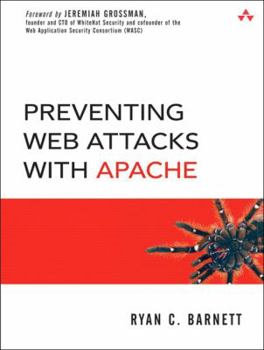
Preventing Web Attacks with Apache

"Ryan Barnett has raised the bar in terms of running Apache securely. If you run Apache, stop right now and leaf through this book; you need this information." -- Stephen Northcutt, The SANS Institute... This description may be from another edition of this product.
Format:Paperback
Language:English
ISBN:0321321286
ISBN13:9780321321282
Release Date:January 2006
Publisher:Addison-Wesley Professional
Length:582 Pages
Weight:0.05 lbs.
Dimensions:1.2" x 7.0" x 9.2"
Related Subjects
Business & Management Client-Server Systems Computer Science Computers Computers & Technology Data in the Enterprise Education & Reference Encryption Internet, Groupware, & Telecommunications Languages & Tools Network Security Networking Programming Security & Encryption Software Design & Engineering Software Design, Testing & Engineering Software Development Software Engineering Web Development & Design Web ServersCustomer Reviews
4 ratings
super
Published by Thriftbooks.com User , 19 years ago
Thanks a lot, we are very happy to have this book in our library!
A strong mix of Apache security and Web application assessment
Published by Thriftbooks.com User , 19 years ago
I recently received copies of Apache Security (AS) by Ivan Ristic and Preventing Web Attacks with Apache (PWAWA) by Ryan Barnett. I read AS first, then PWAWA. Both are excellent books, but I expect potential readers want to know which is best for them. The following is a radical simplification, and I could honestly recommend readers buy either (or both) books. If you are more concerned with a methodical, comprehensive approach to securing Apache, choose AS. If you want more information on offensive aspects of Web security, choose PWAWA. Author Ryan Barnett takes a wider look at the world of Web application security than Ivan Ristic. As a result I find their two books very complementary. You'll find coverage of topics in PWAWA that do not appear in AS. For example, Ryan explains how to use the Center for Internet Security Apache Benchmark Scoring Tool to evaluate your httpd.conf file. He uses the Apache Benchmark (ab) application (packaged with Apache) to measure Web server performance characteristics. He uses these tools in before-and-after situations to show how his recommended changes improve the defaults. I thought PWAWA's coverage of the fundamentals of Web security was not as good as that of AS. That's ok, though, because PWAWA addresses areas not as well covered by AS. For example, PWAWA spends a lot of quality ink on mod_security filters. This is ironic, given that AS author Ivan Ristic coded mod_security! What's impressive about PWAWA's mod_security explanations are the many sample filters. These are developed after discussions of various attack techniques and serve as countermeasures one can implement until a patch is ready. PWAWA is a mix of defense and offense, with a whole chapter showing how to attack and defend the WebMaven/Buggy Bank learning Web application. Attacks are nice, but showing development of defenses is excellent. PWAWA features some clever ideas too, like snort2modsec.pl and an Open Web Proxy Honeypot. I was not as keen on the inclusion of the Web Application Security Consortium's Web Security "Threat" Classification document. Please search my blog for a thorough discussion of why that guide should be an "attack, vulnerabilities, and exposures" document. I found few technical nits. It's not correct that a NIDS protects its sniffing interface by "removing [the] IP stack" (p 299). Inline IDS isn't just for honeypots, either. I could have used inline packet rewriting to defend a Web hosting company that had lost control of its IIS customer sites. The customers were compromised and were unwittingly attaching malicious frames in their Web pages, thanks to an intruder. I was also concerned by the author's statement that upon seeing a Snort Web attack alert, he connects to the Web server via SSH and begins reviewing logs (p 419). Proper network security monitoring wouldn't necessarily require immediate log review, and if log review is needed it should be done via a central log host. Connecting
Thorough security work on Apache
Published by Thriftbooks.com User , 20 years ago
This book is a well written, in depth, look into the security issues around Apache and applications developed on top of Apache. The content is relevant, well explained, and very useful to both applications engineers and network security folks. Definitely a must read for those looking to deploy high load applications on the open Internet.
bolt down your Apache!
Published by Thriftbooks.com User , 20 years ago
Apache is the most common web server out there. It has been heavily built up in functionality by volunteer programmers. Naturally, there are numerous books detailing all that you can do with it. Very versatile. Unfortunately, that is one of the problems! As many commercial websites use Apache, there is a huge incentive for crackers to subvert it in various fashions. Perhaps to get at the back end SQL database. In which might be stored useful information like people's names and credit card data. Barnett offers inoculation. You can read this book as the sysadmin's manual to installing and running Apache. Where the overriding priority is to bolt down any known weaknesses from the get go. There is a comprehensive list of attacks. Some might not necessarily be directed against Apache per se, but against any web server. But there are others that might scan for particular versions of Apache or the operating system, if these have bugs that can be exploited. The text suggests possibly providing disinformation. In an earlier, more innocent time, a web server might write its name and version at the bottom of a page that it publishes, for example. Now, you are shown how Apache can suppress this. Better yet, you can tell Apache to pretend to be another web server. A defensive fib that makes the cracker's job a little harder. Buffer overflows, cross site scripting and SQL injection are possibly the most dangerous attacks explained. For each attack, examples are usually given. Followed by Apache countermeasures. Tangentially, you also get to cast scrutiny at your database and at the entire way your multitier server system is arranged. The book is a sad but necessary commentary on the times we live in.
Copyright © 2026 Thriftbooks.com Terms of Use
| Privacy Policy | Do Not
Sell/Share My Personal Information | Cookie Policy | Cookie Preferences | Accessibility Statement
ThriftBooks® and the ThriftBooks® logo are registered trademarks of Thrift Books Global, LLC
ThriftBooks® and the ThriftBooks® logo are registered trademarks of Thrift Books Global, LLC
