


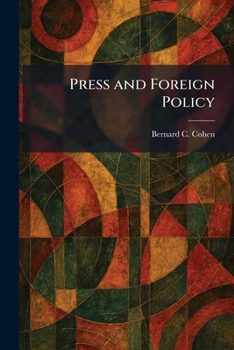
Press and Foreign Policy

Select Format
Select Condition 
Book Overview
"Press and Foreign Policy" provides a foundational analysis of the complex interplay between the news media and the development of international affairs. Bernard C. Cohen examines the specific roles that journalists and government officials inhabit, exploring how the press acts as a bridge between the state and the public. The work investigates the degree to which media coverage influences diplomatic priorities, political decision-making, and the broader perception of global events.
Through a detailed study of the communication process, Cohen identifies the press as a critical participant in the foreign policy arena rather than a passive observer. The book delves into the pressures of reporting from the capital, the constraints of official secrecy, and the methodologies used by reporters to translate international crises for a domestic audience. This work is a seminal text in political science and communication studies, offering timeless insights into how news serves as both a tool for policymakers and a monitor of government action. It remains an essential read for those interested in the dynamics of the fourth estate and its impact on the world stage.
This work has been selected by scholars as being culturally important, and is part of the knowledge base of civilization as we know it. This work was reproduced from the original artifact, and remains as true to the original work as possible. Therefore, you may see the original copyright references, library stamps (as most of these works have been housed in our most important libraries around the world), and other notations in the work.
This work is in the public domain in the United States of America, and possibly other nations. Within the United States, you may freely copy and distribute this work, as no entity (individual or corporate) has a copyright on the body of the work.
As a reproduction of a historical artifact, this work may contain missing or blurred pages, poor pictures, errant marks, etc. Scholars believe, and we concur, that this work is important enough to be preserved, reproduced, and made generally available to the public. We appreciate your support of the preservation process, and thank you for being an important part of keeping this knowledge alive and relevant.
Customer Reviews
ThriftBooks ® and the ThriftBooks ® logo are registered trademarks of Thrift Books Global, LLC
