


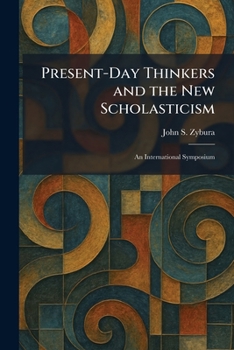
Present-Day Thinkers and the New Scholasticism: An International Symposium

Select Format
Select Condition 
Book Overview
"Present-Day Thinkers and the New Scholasticism" is an expansive international symposium edited by John S. Zybura that investigates the relationship between traditional Scholastic philosophy and the evolving intellectual landscape of the early twentieth century. This collaborative work gathers perspectives from a diverse array of global scholars to assess the vitality and relevance of the New Scholastic movement-a revival of the philosophical principles of St. Thomas Aquinas and his successors-in dialogue with modern scientific and speculative thought.
The text explores core themes of metaphysics, epistemology, and ethics, seeking to demonstrate how the rigorous logic and systematic framework of Scholasticism can address contemporary philosophical problems. By presenting a cross-section of international discourse, the volume highlights the shared concerns and divergent approaches of thinkers engaged in the Neo-Thomistic revival. This work remains a significant historical and intellectual document, offering deep insights into the Catholic intellectual tradition and its persistent engagement with the modern world. It is an essential resource for students of philosophical history, theology, and the development of modern Christian thought.
This work has been selected by scholars as being culturally important, and is part of the knowledge base of civilization as we know it. This work was reproduced from the original artifact, and remains as true to the original work as possible. Therefore, you may see the original copyright references, library stamps (as most of these works have been housed in our most important libraries around the world), and other notations in the work.
This work is in the public domain in the United States of America, and possibly other nations. Within the United States, you may freely copy and distribute this work, as no entity (individual or corporate) has a copyright on the body of the work.
As a reproduction of a historical artifact, this work may contain missing or blurred pages, poor pictures, errant marks, etc. Scholars believe, and we concur, that this work is important enough to be preserved, reproduced, and made generally available to the public. We appreciate your support of the preservation process, and thank you for being an important part of keeping this knowledge alive and relevant.
Customer Reviews
ThriftBooks ® and the ThriftBooks ® logo are registered trademarks of Thrift Books Global, LLC
