


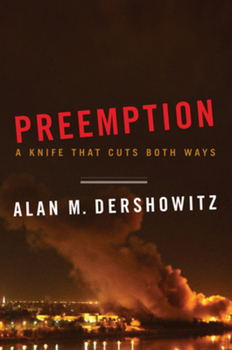
Preemption: A Knife That Cuts Both Ways (Issues of Our Time)

Select Format
Select Condition 
Book Overview
About the series: Issues of Our Time "Aware of the competition for the attention of readers, W. W. Norton & Company and I have created the "Issues of Our Time" as a lucid series of highly readable books through which some of today's most thoughtful intellectuals seek to challenge the general reader to reexamine received truths and grapple with powerful trends that are shaping the world in which we live. The series launches with Anthony Appiah, Alan Dershowitz, and Nobel Laureate Amartya Sen as the first of an illustrious group who will tackle some of the most plangent and central issues defining our society today through books that deal with such issues as sexual and racial identities, the economics of the developing world, and the concept of citizenship in a truly globalized twenty-first-century world culture. Above all else, these books are designed to be read and enjoyed." -- Henry Louis Gates Jr., W. E. B. DuBois Professor of the Humanities, Harvard University
Format:Hardcover
Language:English
ISBN:0393060128
ISBN13:9780393060126
Release Date:February 2006
Publisher:W. W. Norton & Company
Length:348 Pages
Weight:1.23 lbs.
Dimensions:8.5" x 1.2" x 5.9"
Customer Reviews
5 ratings
We Don't Want to Go There
Published by Thriftbooks.com User , 19 years ago
In this recently published book, Harvard law professor and lawyer Alan Dershowitz raises some questions about our fundamental assumptions about preventing harmful behavior from individuals and states. He asserts that in the age of terror traditional assumptions no longer suffice and that new tools of jurisprudence are needed to respond to a new kind of threat. The traditional assumption has been to rely on the rational person standard of behavior which presupposes that a rational person would be deterred from inflicting harm by the threat of punishment. Under this theory the perpetrator would do a cost/benefit analysis of his or her actions and act accordingly. Now, however, in the age of suicidal terrorists with possible access to weapons of mass destruction this assumption no longer holds. Given these circumstances, Dershowitz argues that there is now a potential need for profiling, preventative detention, forceful interrogation, restraint on free speech, targeted assasinations of terrorists, and preemptive military action. More importantly, he argues that we need a new jurisprudence to regulate these actions in these areas. For Dershowitz the old maxim that it is better to release ten guilty than to detain one innocent no longer applies; it is better to detain one innocent then to let ten terrorist attacks occur. The legal mechanism that Dershowitz proposes to regulate the actions of the state are as follows: "the seriousness of the contemplated harm, discounted by the unlikelihood that it would occur in the absence of preemption, would be greater than the likelihood of the harms caused by successful preemption, discounted by the likelihood (and costs) of failed (and successful) preemption." This cost/benefit analysis is a balancing of the probablities. In this balancing, there is obviously a wide margin for error. I can't really see the White House pondering this formula when considering preemptive action nor can I see them being held accountable to it. Dershowitz also sees the problems with preemption; it is indeed a knife that cuts both ways. In the Six-Day War of 1967, Israel acted preemptively toward the gathering threat of the Arab countries when it was clear they were going to invade Israel. However, in the 1973 Yom Kippur War, Israel was then an occupying force and preemption was no longer an option due to probable international condemnation. In a more recent example, the United States military action in Iraq would have been justified to some extent had there been weapons of mass destruction and the regime's imminent intention to use them. Since none were found the entire project lacked international legitimacy. And the negative byproduct of this preemptive action, is that it has only emboldened Iran and North Korea to produce nuclear weapons while the United States can do nothing. It shows that preemptive action can lead not only to expensive and lengthy military actions, it can and will undermine future preemptive a
Past history, present actions and possible future scenarios
Published by Thriftbooks.com User , 20 years ago
As the military world moves increasingly towards making preemptive moves in the name of 'preventing' war, PREEMPTION: A KNIFE THAT CUTS BOTH WAYS becomes an increasingly important study. Author Alan M. Dershowitz is a lawyer and educator who traces society's shift in its approach to controlling dangerous human behaviors, from the local to the world level. A number of current examples charts these moves, from the tendency to profile suspicious behaviors to instigating proactive measures rather than reactive responses. Contrasting this approach to Cold War and other approaches, Dershowitz places in perspective past history, present actions and possible future scenarios. Diane C. Donovan, Editor California Bookwatch
An amazing amount of history; undogmatic
Published by Thriftbooks.com User , 20 years ago
The issue is, of course, the U.S. invovlement with Israel, in Iraq, and with radical Islam in general. We Americans have attempted to distill them down to simple essences such as "Bush Lied, People Died" and "These Colors Don't Run." These issues require a historical context, which Derschowitz richly provides, in the history of the Jewish people and the Israeli nation, and in both American and world jurisprudence. In the end, the questions for America are whether or not preemptive action was justified in Iraq, would be justified to head off a nuclear Iran or North Korea. Also in question is whether Israel is justified in its ongoing preventative/preemptive strikes against terrorists. Dershowitz examines the rationale behind the traditional role of justice as punishing crimes once committed: society is able to absorb a first strike by an evil-doer, and said evil-doer is likely to be deterred by the threat of punishment. In our current state, however, the evil-doers do not mind death, but rather they seek it. Furthermore, they will be armed with the most awful weapons they can acquire. What then? A good and scholarly examination of weighty questions.
Terrific Read
Published by Thriftbooks.com User , 20 years ago
Not only is this the first serious attempt to outline how we should think about preemptive and preventive military action, but it's a fascinating historical and philosophical examination of the entire field of preemptive state action. Dershowitz makes good use of his legal background in analogizing ways in which the criminal justice system uses and misuses preemptive profiling, detention, and civil commitment to foreign policy and military questions. As always with Dershowitz, the style is fast, direct, and accessible. All in all, an unusually thoughtful book and a thoroughly enjoyable read.
Dershowitz finally wrote his magnum opus
Published by Thriftbooks.com User , 20 years ago
This book is probably the most important one Harvard Law Professor Alan Dershowitz has ever written. In "Preemption: A Knife That Cuts Both Way," Dershowitz analysis one of the most crucial, yet most unexplored paradigm shifts of our time: the shift from deterrence to preemption - a paradigm shift that greatly influences both our domestic and foreign policy, as the White House reaffirmed just last week in its strategy report on national security. And yet, as Dershowitz convincingly shows, to this date there is no jurisprudence that would govern preemption. In his magnum opus, Dershowitz not only shows why we need a jurisprudence of preemption. Employing historical analysis and legal acumen, he also outlines how we could think of such a jurisprudence. With the concern of a civil libertarian, Dershowitz carefully examines the many areas of preemption, which are not regulated by, and thus not subject to, the rule of law, ranging from detention over compulsory vaccinations to humanitarian intervention to stop genocides. Although these topics have been discussed a great deal in the public sphere, no attempt has been made to construct a systematic morality and jurisprudence of preemption that would put these issues in context. Dershowitz has now filled this gap. With "Preemption: A Knife That Cuts Both Way," Dershowitz showed once more why he is widely considered as one of the greatest public intellectuals of our time. A must read for everyone interested in law, morality, and public policy!
Copyright © 2026 Thriftbooks.com
Terms of Use | Privacy Policy | Do Not Sell/Share My Personal Information | Cookie Policy | Cookie Preferences | Accessibility Statement
ThriftBooks ® and the ThriftBooks ® logo are registered trademarks of Thrift Books Global, LLC
ThriftBooks ® and the ThriftBooks ® logo are registered trademarks of Thrift Books Global, LLC
