


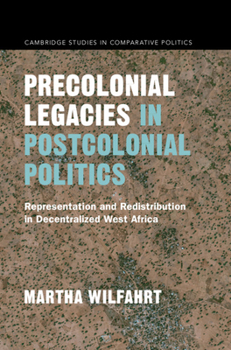
Precolonial Legacies in Postcolonial Politics: Representation and Redistribution in Decentralized West Africa
No Customer Reviews

Why are some communities able to come together to improve their collective lot while others are not? Looking at variation in local government performance in decentralized West Africa, this book advances a novel answer to this question: communities are better able to coordinate around basic service delivery when their formal jurisdictional boundaries overlap with informal social institutions, or norms. This book identifies the precolonial past as the driver of striking subnational variation in the present because these social institutions only encompass the many villages of the local state in areas that were once home to precolonial polities. Drawing on a multi-method research design, the book develops and tests a theory of institutional congruence to document how the past shapes contemporary elite approaches to redistribution within the local state. Where precolonial kingdoms left behind collective identities and dense social networks, local elites find it easier to cooperate following decentralization.
Format:Hardcover
Language:English
ISBN:1316518159
ISBN13:9781316518151
Release Date:August 2021
Publisher:Cambridge University Press
Length:300 Pages
Weight:1.40 lbs.
Dimensions:0.9" x 6.0" x 9.0"
Customer Reviews
0 rating
Copyright © 2026 Thriftbooks.com
Terms of Use | Privacy Policy | Do Not Sell/Share My Personal Information | Cookie Policy | Cookie Preferences | Accessibility Statement
ThriftBooks ® and the ThriftBooks ® logo are registered trademarks of Thrift Books Global, LLC
ThriftBooks ® and the ThriftBooks ® logo are registered trademarks of Thrift Books Global, LLC
