


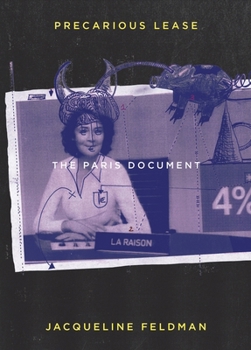
Precarious Lease

At a far edge of Paris where the banlieue began stood Le Bloc: a squat, or an occupied building. Eight stories tall and four basements deep, it took in artists as well as immigrants to France from various corners of Europe, Africa, and the Americas. This was a time when the municipality sought to encourage such occupations by tethering leases to agreements of artistic practice and production. But eviction threatened these squatters existentially.
Their story--in this breathtaking investigation--animates a far-ranging inquiry. Demanding answers to epochal questions about the basis of any right to a space, Le Bloc's shared living project is also a distinguished entry in one city's revolutionary and bohemian past. In the tradition of Walter Benjamin and other chroniclers of Paris, Feldman, an American essayist, draws on this history, playing freely in the tropes of layered Paris while sounding issues of the most contemporary urgency--about hospitality and refuge, ecology and the possibilities left for writing the City of Lights.
In her extraordinary nonfiction debut--in magnetic prose, with gripping candor, journalistic precision, and a painstaking attention to fact as it is shaped by the drive of an eviction plot--Feldman develops a singular and comprehensive ethics of inquiry, claiming for literature all the demands of a form found in the world.
Customer Reviews
ThriftBooks® and the ThriftBooks® logo are registered trademarks of Thrift Books Global, LLC
