


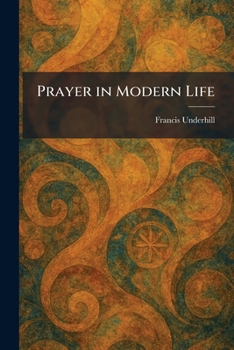
Prayer in Modern Life

Select Format
Select Condition 
Book Overview
"Prayer in Modern Life" is an insightful exploration of the role and practice of spiritual devotion in the context of the early twentieth century. Francis Underhill addresses the unique challenges faced by individuals seeking to maintain a consistent prayer life amidst the increasing noise and pace of contemporary society. The work serves as a practical and theological guide, aiming to bridge the gap between ancient religious traditions and the realities of modern existence.
The text examines the fundamental nature of prayer, moving beyond simple ritual to discuss its necessity as a source of strength, clarity, and connection to the divine. Underhill covers various aspects of the devotional experience, including petition, thanksgiving, and the importance of silence and meditation. By acknowledging the common difficulties of distraction and doubt, the author provides a sympathetic yet encouraging roadmap for the spiritual journey.
Written with both pastoral warmth and intellectual depth, "Prayer in Modern Life" emphasizes that communication with God is not a relic of the past, but a vital, transformative practice for the present day. It remains a valuable resource for those interested in the history of Christian thought and anyone looking to deepen their own interior life through the timeless discipline of prayer.
This work has been selected by scholars as being culturally important, and is part of the knowledge base of civilization as we know it. This work was reproduced from the original artifact, and remains as true to the original work as possible. Therefore, you may see the original copyright references, library stamps (as most of these works have been housed in our most important libraries around the world), and other notations in the work.
This work is in the public domain in the United States of America, and possibly other nations. Within the United States, you may freely copy and distribute this work, as no entity (individual or corporate) has a copyright on the body of the work.
As a reproduction of a historical artifact, this work may contain missing or blurred pages, poor pictures, errant marks, etc. Scholars believe, and we concur, that this work is important enough to be preserved, reproduced, and made generally available to the public. We appreciate your support of the preservation process, and thank you for being an important part of keeping this knowledge alive and relevant.
Customer Reviews
ThriftBooks ® and the ThriftBooks ® logo are registered trademarks of Thrift Books Global, LLC
