


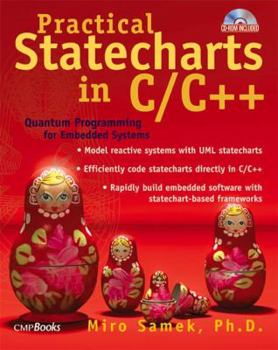
Practical Statecharts in C/C++: Quantum Programming for Embedded Systems with CDROM

'Downright revolutionary... the title is a major understatement... 'Quantum Programming' may ultimately change the way embedded software is designed.' -- Michael Barr, Editor-in-Chief, Embedded Systems Programming magazine (Click here
Format:Paperback
Language:English
ISBN:1578201101
ISBN13:9781578201105
Release Date:July 2002
Publisher:CRC Press
Length:389 Pages
Weight:1.98 lbs.
Dimensions:9.0" x 1.0" x 7.3"
Customer Reviews
5 ratings
Excellent book and code
Published by Thriftbooks.com User , 21 years ago
This book was a definite eye-opener for me with regard to state machines. I recently rewrote a major piece of code to utilize the Quantum Framework (included with the book) and it has worked wonders. My previous code used a more traditional state machine and had quickly evolved into spaghetti code. The hierarchical state machine approach made the new code smaller, more robust, and much easier to maintain and extend.
Excellent, thoughtful and technical treatise on statecharts
Published by Thriftbooks.com User , 22 years ago
Since I am not from the embedded system world, I was a bit apprehensive about approaching this book. While I can see that author Miro Samek has a directed target for his audience, I strongly feel that this book is a "must read" for technical developers in all areas who want to improve their program design abilities or developers who want to understand the philosophy, use, and implementation of statecharts intimately.As the title indicates, this book brings the topic of statecharts from the realm of expensive design tools to the PRACTICAL realm, illustrating its points with full examples and extensive commentary.Essentially Samek postulates that the slow adoption by developers of best practices by statechart design is due to lack of understanding of the fundamental nature of statecharts and how it is perceived as requiring expensive tools to use well. Samek insightfully discusses how statecharts as a best practice embody "behavioral inheritance" as a fundamental design concept that stands as a peer alongside the conventional pillars of object-oriented programming, namely inheritance, encapsulation, and polymorphism.The book is very technical and written in an academic style, with ample references to original sources as well as detailed code reviews and many reader exercises. I would caution anyone from approaching this book as a quick or light read. For me, it took a seriousness and good understanding of C and C++ to follow Samek's examples and achieve the "a-ha", which was always worth it in the end.The two basic parts of the text are (1) an explanation of statecharts and their methodological implications, and (2) a description of how to apply statecharts as a data structure in real applications, namely embedded as control strategies for "active objects." In several places in the text, Samek makes an analogy between statechart (and active object) semantics and quantum mechanics. This parallel was an interesting philosophical argument, but didn't add much for me in terms of accepting his "quantum framework" as a best practice -- I was sold by his methodological arguments he had presented already.Speaking from experience in writing a book about using statecharts to build simulations, I can say Samek is a visionary who extended my perception of statecharts several steps. I know I will be quoting from it and referring to it in my work to come. This book has earned a prominent place on my bookshelf, and I would heartily recommend it to any other developer who wants to create correct, verifiable, scaleable, and solid designs (which should be ALL developers!).
Interesting book opening a whole new world!
Published by Thriftbooks.com User , 23 years ago
I noticed the first version of the hierarchical statemachine framework from Samek in ESP magazine August 2000. It seemed interesting and very efficient but on this book Samek has improved the framework a lot. Multitasking is included for example.In addition the book gives good examples and instructions to use the framework in embedded systems software projects.If you think you should re-think your architectural design in your embedded project read the article in ESP magazine ...
Excellent book on Embedded Framework
Published by Thriftbooks.com User , 23 years ago
I want to congratulate Miro Samek for his book.The book is well structured. The UML Statecharts are well introduced. The Actives Objects approach and the related Framework are very attractive. With the Framework (QF) for embedded real-time systems included, you are really able to use it for your application. You can then focus on your application objects and no more on the "glue" around them. You have a common strategy for all your applications. The best book on UML for embedded system from a long time.
Excellent Book in Embedded Software Design
Published by Thriftbooks.com User , 23 years ago
This book has done a great job in consolidating many key concepts and techniques in embedded software design. Though state machines and event-driven design are not new, the author proposed a truly reusable and integrated framework which is very well designed and particularly suitable for resource constrained embedded systems.Author's implementation of state machines is innovative and remarkable. It supports state nesting, automatic execution of entry/exit actions and default event handling by superstates. This allows you to implement UML statecharts in C++/C conveniently.In general this book is very clearly written and comprehensive. Its reference list is also valuable, pointing to some classics in OOD and good articles in Embedded Systems Programing. This book will definitely become a classic in embedded software itself.On the downside, I find the repeated analogy of the software model to quantum physics overwhelming. Besides the author chose to show you examples and implications before showing you the details and internal. This kind of abstraction may pose some question marks in your mind when you read the first few chapters. But do read on and you will appreciate the great ideas.
Copyright © 2026 Thriftbooks.com Terms of Use
| Privacy Policy | Do Not
Sell/Share My Personal Information | Cookie Policy | Cookie Preferences | Accessibility Statement
ThriftBooks® and the ThriftBooks® logo are registered trademarks of Thrift Books Global, LLC
ThriftBooks® and the ThriftBooks® logo are registered trademarks of Thrift Books Global, LLC
