


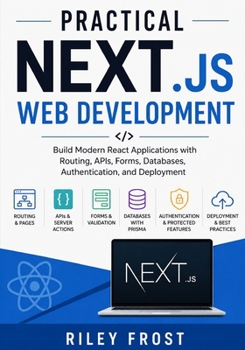
Practical Next.js Web Development: Build Modern React Applications with Routing, APIs, Forms, Databases, Authentication, and Deployment

Book Description
Learn how to build practical web applications with Next.js and React.
Practical Next.js Web Development is a beginner-friendly guide for developers who want to move beyond basic React components and start building structured, full-stack web applications with Next.js.
This book introduces the core parts of modern Next.js development in a clear, practical way. You will learn how to create pages with the App Router, build reusable React components, work with layouts and navigation, manage interactivity with Client Components, handle forms, create API routes, connect to a database, and prepare an application for deployment.
Instead of overwhelming you with unnecessary theory, this book focuses on practical development patterns you can understand and apply step by step. Each chapter builds on the previous one, helping you see how routes, components, forms, APIs, databases, authentication concepts, and protected features work together in a real project.
Inside this book, you will learn how to:
Set up a modern Next.js project
Understand the App Router, pages, nested routes, and layouts
Build reusable React components with props and composition
Use Server Components and Client Components correctly
Manage state, events, and conditional UI
Build forms and handle user input
Validate form data and show useful feedback
Create Route Handlers for API requests
Fetch data with loading, error, and empty states
Connect a Next.js application to a database with Prisma
Build create, read, update, and delete features
Understand authentication, sessions, and protected routes
Prepare and test a Next.js project before deployment
The book also includes a focused final project: a practical task dashboard that brings together routing, reusable components, forms, APIs, database-backed features, basic protected checks, and deployment preparation.
This book is suitable for readers who already know the basics of HTML, CSS, JavaScript, and React, and want a clear path into building more complete applications with Next.js.
By the end, you will have a stronger understanding of how to structure a Next.js project and how the main parts of a full-stack React application fit together.
Customer Reviews
ThriftBooks ® and the ThriftBooks ® logo are registered trademarks of Thrift Books Global, LLC
