


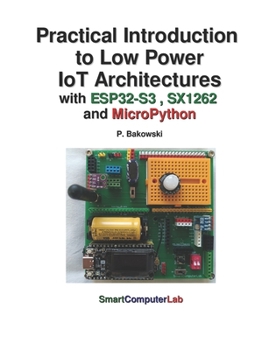
Practical Introduction to Low Power IoT Architectures with ESP32-S3, SX1262 &nd MicroPython

n this book and the associated laboratories, we will explore the low-power characteristics of IoT
systems after first implementing and validating their essential functional features on the provided IoT
SoCs and development boards.
Through the laboratories, we will study several aspects of low-power operation related to both
processing and communication. In particular, we will distinguish between the high-power state, in
which all operational phases such as initialization, sensing, transmitting, and receiving take place, and
the low-power state, in which the device remains in sleep or idle mode.
We will show that current consumption in the low-power stage is a key factor in reducing overall
energy usage during operational cycles. The lower the current in this stage and the longer its duration,
the lower the total power consumption of the device. In our target system, the average current in the
low-power stage is expected to be around 15 A.
This book and its laboratories will involve three types of communication links and three categories
of terminal devices. Directly connected devices will operate using Wi-Fi links, close devices will
use the Wi-Fi MAC layer through ESP-NOW, and remote devices will rely on long-range LoRa radio
links. Close and remote devices will require intermediate router or gateway nodes to access the
Internet using the IP protocol.
The analysis and optimization of power (current) consumption will be carried out using the Power
Profiler Kit II (PPK2). This measurement device will allow us to observe and analyze the current
consumption of the connected IoT development kits.
Using the PPK2, we will optimize power consumption by introducing control parameters such as
delta, cycle time, and threshold value. These parameters will enable us to tune the power
consumption to the required level.
By comparing the energy efficiency of different radio links such as Wi-Fi, ESP-NOW, and LoRa, we
will demonstrate that, during the high-power state, the transmission phase accounts for the largest
share of energy consumption. This cost will be highest for Wi-Fi communication and for long
transmission phases with LoRa radio links.
Finally, the laboratories will show that the lowest energy consumption can be achieved using ESP-
NOW packet transmission and LoRa packet transmission with short packets and low spreading
factors, such as SF7 or SF8.
These labs may be considered a starting point for the development of more specific applications using
various types of sensors, actuators, and terminal devices. The DevKits, available in the form of Gerber
files, can be produced and adapted for use in professional teaching classes as well as in industrial
development laboratories.
All development software presented in this book and in the associated laboratories is implemented
using MicroPython. The use of MicroPython allows rapid prototyping and clear program structure
while maintaining direct access to the hardware features of the IoT SoCs. This approach makes the
laboratories accessible for educational purposes while remaining suitable for advanced experimentation
and low-power optimization.
Customer Reviews
ThriftBooks ® and the ThriftBooks ® logo are registered trademarks of Thrift Books Global, LLC
