


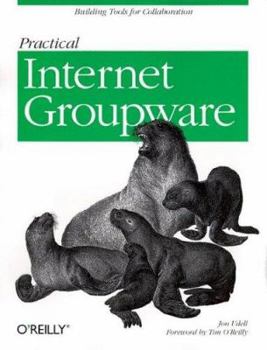
Practical Internet Groupware


Collaboration. From its academic roots to the bustling commerce sites of today, the Internet has always been about collaboration: providing a means for people to communicate and work together... This description may be from another edition of this product.
Format:Paperback
Language:English
ISBN:1565925378
ISBN13:9781565925373
Release Date:October 1999
Publisher:Oreilly & Associates Inc
Length:497 Pages
Weight:1.35 lbs.
Dimensions:9.3" x 1.0" x 7.3"
Customer Reviews
5 ratings
An avant-garde proposition that foreshadow web 2.0
Published by Thriftbooks.com User , 20 years ago
In his book "Practical Internet Groupware", former BYTE magazine editor Jon Udell layout an architecture that links human minds into collaborative relationships. Base on his actual experience in building BYTE's intranet as well as the magazine's public online services, he gave his insight on the powerful use of Internet. Among the many IT books I have read, this book stand out as sublime, even avant-garde. Got a question? Search the Internet, send a follow up email to folks you have never met. That's something many of us have probably done without much thinking. Yet Jon would step back and reflect on the dynamic that had happened. An ad-hoc workgroup was formed between him and several person on one particular task. The collaboration was unbounded by time, geography or corporate affiliation. He strived to grasp the subtle interactions and to facilitate this flow of information on the Internet. People are lazy and do not like to learn or adapt to complex rules impose by computer systems. On the other hand simple rules and clever UI tweak can often make interactions spontaneous and effective. Use an appropriate subject for a message is one good example. The author discussed one of the oldest groupware on the Internet, the Usenet newsgroups. He termed it conferencing and explained why it is a better channel for some kind of interactions compare to email. Many of us who get caught in lengthy email debate would be delighted to know there are more effective way to conduct this kind of discussion. Indeed a seamless integration of web, email, newsgroup and a searchable document database are the components that make a formidable groupware application. Unlike most IT books, he did not focus on any single platform, computer language or a technology. Whether it is a tool from Microsoft or its competitors, a freeware or a commercial product, he would use it if he see fits. Throughout the book are short, unglamorous, but nevertheless working code samples. Given I read this 6 years after its 1999 publishing date, many of the code or specific technologies are already considered obsoleted. Yet the insight that stem from these early system are just as relevant today. Think just what is the core component of web 2.0 technology? User participation! Perhaps nothing reveal more about this book than its front cover. The 'practical' in the 'Practical Internet Groupware' means everything is derived from actual experience and real code rather than a theoretical discussion. Yet it is in small print while the 'Internet Groupware' is emphasize in the banner. That's because the code and the actual systems are just starting points that spawn the exploration of threads that link people into collaborative relationship. This is an immensely powerful Internet application we have yet to master.
Revolutionary
Published by Thriftbooks.com User , 26 years ago
It's amazing how many capabilities there are in MS and Netscape suites (browser + mail reader + news reader) and how they work together. Using SMTP, HTTP and NNTP as the foundation, Udell gives us a vision for the future of online collaboration (even though WebDAV only get passing mention). If you are building an intranet, this is the second book you should read after Philip and Alex's Guide to Web Publishing. To build an intranet in the year 2000 without NNTP capability should be a crime.
Excellent--A Must Buy for Internet Forum Managers
Published by Thriftbooks.com User , 26 years ago
This is an excellent book. When I first encountered it I wasn't really impressed by the title since I doubted someone could say anything new or interesting about Usenet. Sometime later, though, I read Tim O'Reilly's review in his "Ask Tim" column. Tim recommended it so highly that I picked it up the next time I hit the bookstore. I'm very glad I did because Jon Udell has done a great job of looking at modern groupware concepts and applications, while also giving intelligent treatment to the historical roots of groupware in systems like Usenet.This isn't a book about Usenet, or Lotus Notes, or any specific groupware product. It is about building and maintining modern groupware systems, and it examines this topic from a variety of conceptual and practical angles. This book provides a lot of ideas--good ones. Many of the ideas are so wonderful because Jon always keeps an eye on the future, and provides advice toward ensuring that groupware systems use the best of current technology (e.g., XML) but still remain flexible for future developments. If you manage discussion forums of any kind, or are considering doing so, I recommend that you pick this book up.
a typical classic: have a vision, but too weird
Published by Thriftbooks.com User , 26 years ago
it has a vision, and a good start. but too weird. The author seems like to use peculiar way and terminology to express easy and common practice. e.g. ordinary cgi, database-driven, and the importance of LWP. Yes, perhaps by means of that, it provides some antidote for the everyday practice and good for seeing the vision he presents, but it makes it unnecessarily difficult. however, still worth for reading. It is a big picture book, although there are also a lot of codes (java and perl).I really hate it -- because it is really a must read (ya, the MUST!) for web-engineer, while I clearly know that the author can make it much easier for us.
Practical insights often overlooked
Published by Thriftbooks.com User , 26 years ago
Jon's book is not typical. It does not provide the same old information about HTTP or HTML or NNTP. It provides a look at what he has learned about writing Internet applications for his office. The software is general enough to be applied to other kinds of offices (his is publishing). The principles and insights are general enough to lead to brand new kinds of Internet applications.The book does get into enough of the details of NNTP, HTTP, HTML, XML, Perl, Java, etc. to serve as examples of using those technologies, but you'll also need the manuals to go out on your own.A very *practical* book!
Copyright © 2026 Thriftbooks.com
Terms of Use | Privacy Policy | Do Not Sell/Share My Personal Information | Cookie Policy | Cookie Preferences | Accessibility Statement
ThriftBooks ® and the ThriftBooks ® logo are registered trademarks of Thrift Books Global, LLC
ThriftBooks ® and the ThriftBooks ® logo are registered trademarks of Thrift Books Global, LLC
