


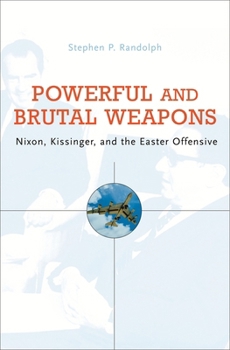
Powerful and Brutal Weapons: Nixon, Kissinger, and the Easter Offensive

Select Format
Select Condition 
Book Overview
As America confronts an unpredictable war in Iraq, Stephen Randolph returns to an earlier conflict that severely tested our civilian and military leaders. In 1972, America sought to withdraw from Vietnam with its credibility intact. As diplomatic negotiations were pursued in Paris, President Richard Nixon and National Security Advisor Henry Kissinger hoped that gains on the battlefield would strengthen their position at the negotiating table--working against the relentless deadline of a presidential election year.
In retaliation for a major North Vietnamese offensive breaking over the Easter holidays, the President launched the all-out air campaign known as Linebacker--overriding his Secretary of Defense and clashing with the theater commander in whom he had lost all confidence. He intended to destroy the enemy with the full force of America's "powerful and brutal weapons" and thus shape the endgame of the war. Randolph's narrative, based not only on the Nixon White House tapes and newly declassified materials from the National Security Council, the Pentagon, and the White House but also on never before used North Vietnamese sources, re-creates how North Vietnam planned and fought this battle from Hanoi and how the U.S. planned and fought it from Washington. Randolph's intimate chronicle of Nixon's performance as commander-in-chief gains us unprecedented access to how strategic assessments were made, transmitted through the field of command, and played out in combat and at the negotiating table. It is a compelling story about America's military decision-making in conflicts with nontraditional belligerents that speaks provocatively to our own time.Format:Hardcover
Language:English
ISBN:0674024915
ISBN13:9780674024915
Release Date:March 2007
Publisher:Harvard University Press
Length:416 Pages
Weight:1.70 lbs.
Dimensions:1.5" x 6.4" x 9.4"
Customer Reviews
2 ratings
Comprehensive story of Nixon and the Easter Offensive
Published by Thriftbooks.com User , 16 years ago
The title, Brutal and Powerful Weapons, does not give much insight into what kind of book this is. It comes from a North Vietnam Politburo cable sent March 27, 1972, the eve of the Easter Offensive. It does, though, point to the diversity of sources that Randolph uses to tell a complete story. The book is well documented and carefully adheres to the truth. Randolph skillfully weaves several related threads into a fabric that tells many aspects of the Vietnam War during the 1972 Easter Offensive. There is the thread of Nixon and Kissinger interacting with the North Vietnamese politburo Paris negotiators. Nixon and Kissinger working for détente with the USSR and the Peoples Republic of China. Nixon interacting with cabinet members (or not interacting, but rather bypassing them) and generals. Another three threads are the North Vietnamese attacks on Quang Tri (and nearby Hue), Kontum, and An Loc. Two more are the air operations in South Vietnam in support of the ARVN and the Linebacker air operations against North Vietnam. The book shifts, somewhat abruptly, from the diplomatic processes between the United States, North Vietnam, the U.S.S.R, and Red China, to the combat in South Vietnam, to the air war in North Vietnam, then repeating the cycle. The combat chapters are essential for understanding the diplomacy chapters, and they are all mixed about as well as could be done. But at times I felt like I was reading two separate books. I was stunned to learn that Nixon and Kissinger were so dissatisfied with the Air Force and Navy aviation. Thousands of pilots and crewmembers died or were taken prisoner, and they weren't satisfied with what was accomplished. Part of why Nixon was dissatisfied was that Kissinger was deceiving him. The Air Force would ask for permission to bomb the buildups in the North Vietnam panhandle, then Laird and Kissinger would deny the request, then Nixon would throw a temper tantrum because the Air Force wasn't bombing the panhandle. Nixon also threw a tantrum because the Air Force could not bomb effectively in bad weather. He argued that the Army Air Force bombed effectively in bad weather during World War II at the Battle of the Bulge, so why couldn't they do it in Vietnam. Well this just wasn't true. The Army Air Force was limited by weather during the Battle of the Bulge. Where did Nixon get this idea? Nixon and Kissinger were just terribly out of touch with the realities of what the military was doing, what was feasible for them to do, what it was like for the soldiers and pilots, and what the limitations were. General Haig and Admiral Moorer should have done a better job of explaining military realities to Nixon and Kissinger. (My conclusions, not Randolph's, who just presents the facts.) I was personally interested when I read that an A-37 was shot down near An Loc on May 11, 1972, and for a couple of hours the air operations were focused on rescuing the pilot. (p 246) One B-52 strike was
How the U.S. Miltiary Saved South Vietnam in 1972
Published by Thriftbooks.com User , 18 years ago
Few Americans are familiar with the belated successes achieved by U.S. Air Force and Navy air power against the North Vietnamese offensive in 1972. With this definitive study, Stephen Randolph (a former USAF fighter pilot now teaching at the National Defense University) tells the full story of the crisis--tactical, strategic, diplomatic, and political. His book reveals a wealth of new information culled from the infamous White House tapes, recently declassified files of the National Security Council, available North Vietnamese records (translated by former CIA intelligence officer), and the history programs of all four U.S. armed services. With optimistic goals similar to those in the famous Tet offensive of early 1968, North Vietnam launched a 3-pronged invasion of the south in March 1972. Employing its growing arsenal of armor and artillery, the North Vietnamese Army achieved stunning early victories facilitated by ineffective resistance by South Vietnamese forces. But the North's advances gradually stalled because of logistical shortcomings, tactical mistakes, and most significantly, "powerful and brutal weapons" that its Politburo, on the eve of operations, had feared might be used by the United States. Even so, the North Vietnamese had seriously underestimated American technological progress in weapon systems since the end of operation Rolling Thunder in 1968 and the resolve of a different American commander-in-chief to use them. President Richard Nixon was not about to let a defeat in Vietnam undermine his diplomatic initiatives with the Soviet Union and China or his reelection in November. Although Randolph unsparingly documents the paranoia, bureaucratic back-stabbing, and dysfunctional decision-making process of Nixon and his national security advisor, Henry Kissinger, he gives them full credit for the result of these decisions. Nixon's hopes of rescuing South Vietnam depended on the growing strategic mobility of American air power. As the crisis unfolded, several hundred USAF combat aircraft rushed to Southeast Asia, where they were joined by five U.S. Navy aircraft carriers. This rapid deployment of forces across such vast distances, explains Randolph, "demonstrated a capability never before seen in strategic affairs" and represented "a turning point in contemporary military history." The book vividly portrays key players involved on the American side of the drama along with their various agendas. Of special interest to Air Force readers is the role of Gen. John Vogt, whose chief qualification for being given leadership of Seventh Air Force (the USAF command in Southeast Asia) was Kissinger's friendship and Nixon's trust. The two of them held most other Air Force leaders in contempt. Randolph is generous in recognizing success and seems fair in analyzing failure. The massive impact of the US Strategic Air Command's B-52 bombers (Nixon's favored weapon) and the well-aimed firepower of Air Force AC-130 gunships were esp
Copyright © 2026 Thriftbooks.com Terms of Use
| Privacy Policy | Do Not
Sell/Share My Personal Information | Cookie Policy | Cookie Preferences | Accessibility Statement
ThriftBooks® and the ThriftBooks® logo are registered trademarks of Thrift Books Global, LLC
ThriftBooks® and the ThriftBooks® logo are registered trademarks of Thrift Books Global, LLC
