


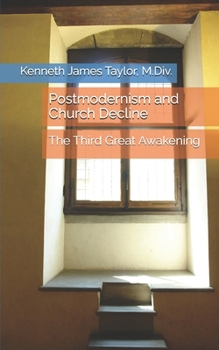
Postmodernism and Church Decline: The Third Great Awakening
No Customer Reviews

Churches are losing attendance. Why? What can we do about it? These are the most common questions asked in church governance committees today. Membership is the lowest it has been since 1940 and a third of those who grew up in church have disaffiliated. Projections suggest that only 25% of Americans will belong to a church by 2100 and half the churches in the U.S. could close. So, what's going on?
Developments in science and philosophy, gender, race, age, color, marital status, and discrimination will describe the bifurcation of Modern Christianity and Postmodern Christianity. This thesis will also compare what isn't working to what is working in Postmodern Christianity, beginning with how visitors are welcomed and why friends and family aren't enough to sustain church growth.
There is hope.
Congregants tend to gravitate toward familiar faces. It is in our human nature. And that nature also tends to disregard unfamiliar faces, the faces of church visitors who Christ wants to reach with the Good News. These are also the faces of those who never come back to our churches. We will examine the reasons why they won't come back and a possible solution.
Church Governance Committees think the solution is to attract Millennials and Generation Z to their congregations. To accomplish this they seek young candidates to fill pastoral and staff positions, believing that youth attracts youth. And they urge them to join small groups. But small groups as well as church attendance remain in decline.
During the 1990's America experienced an explosion of small group ministries that was inspired by psychologist Kurt Lewin's 1940's and 50's encounter group experiments. Churches applied his ideas to small home groups for the purpose of assimilation, promoting fellowship and raising attendance. The inner working of small group successes and failures will be dissected and examined in detail.
Small groups usually meet in private homes, read and discuss scripture, pray for each other and return home without slogging through the mud and debris of depression, broken marriages, drug and alcohol abuse, infidelity, greed, selfishness and hate, which is the type of encounter Millennials and Generation Z need.
That isn't all they need.
Millennials and Gen Z need social media. They are connected since preadolescence. It also isolates them from the collective effervescence experienced in corporate worship, which will lead us into an exploration of the effects of Social media on Postmodern Christianity.
Postmodern generations also need their music. The technology and artistry needed to produce their music exceeds the technology of traditional Christian music. It reverberates with youthful energy. Modern era Christians might not like it, but postmodern music can be used to prepare listeners to receive the pastor's message. Unfortunately, the traditional music Modern Christianity prefers will probably drive younger generations away from church. But there is another pocket of amazing growth in America that ties all of this together.
In American Christianity there is a movement growing exponentially while in general church attendance remains in decline. Churches with congregations over 2000 have increased from 350 to over 1,600 and there is no end in sight.
What are they doing right that the rest of us are not doing?
This is the central topic of this thesis. We will take apart and examine their welcoming and music formats, the unique characteristics of their pastors and sermons, their alter calls, and their orientation and assimilation programs.
The Third Great Awakening begins with understanding the bifurcation of Modern and Postmodern Christianity. Then applying proven postmodern worship principles will give any church the ability to attract Millennials and Generation Z to their worship services and keep them coming back.
Developments in science and philosophy, gender, race, age, color, marital status, and discrimination will describe the bifurcation of Modern Christianity and Postmodern Christianity. This thesis will also compare what isn't working to what is working in Postmodern Christianity, beginning with how visitors are welcomed and why friends and family aren't enough to sustain church growth.
There is hope.
Congregants tend to gravitate toward familiar faces. It is in our human nature. And that nature also tends to disregard unfamiliar faces, the faces of church visitors who Christ wants to reach with the Good News. These are also the faces of those who never come back to our churches. We will examine the reasons why they won't come back and a possible solution.
Church Governance Committees think the solution is to attract Millennials and Generation Z to their congregations. To accomplish this they seek young candidates to fill pastoral and staff positions, believing that youth attracts youth. And they urge them to join small groups. But small groups as well as church attendance remain in decline.
During the 1990's America experienced an explosion of small group ministries that was inspired by psychologist Kurt Lewin's 1940's and 50's encounter group experiments. Churches applied his ideas to small home groups for the purpose of assimilation, promoting fellowship and raising attendance. The inner working of small group successes and failures will be dissected and examined in detail.
Small groups usually meet in private homes, read and discuss scripture, pray for each other and return home without slogging through the mud and debris of depression, broken marriages, drug and alcohol abuse, infidelity, greed, selfishness and hate, which is the type of encounter Millennials and Generation Z need.
That isn't all they need.
Millennials and Gen Z need social media. They are connected since preadolescence. It also isolates them from the collective effervescence experienced in corporate worship, which will lead us into an exploration of the effects of Social media on Postmodern Christianity.
Postmodern generations also need their music. The technology and artistry needed to produce their music exceeds the technology of traditional Christian music. It reverberates with youthful energy. Modern era Christians might not like it, but postmodern music can be used to prepare listeners to receive the pastor's message. Unfortunately, the traditional music Modern Christianity prefers will probably drive younger generations away from church. But there is another pocket of amazing growth in America that ties all of this together.
In American Christianity there is a movement growing exponentially while in general church attendance remains in decline. Churches with congregations over 2000 have increased from 350 to over 1,600 and there is no end in sight.
What are they doing right that the rest of us are not doing?
This is the central topic of this thesis. We will take apart and examine their welcoming and music formats, the unique characteristics of their pastors and sermons, their alter calls, and their orientation and assimilation programs.
The Third Great Awakening begins with understanding the bifurcation of Modern and Postmodern Christianity. Then applying proven postmodern worship principles will give any church the ability to attract Millennials and Generation Z to their worship services and keep them coming back.
Format:Paperback
Language:English
ISBN:B0C87SFJK3
ISBN13:9798397915090
Release Date:June 2023
Publisher:Independently Published
Length:248 Pages
Weight:0.55 lbs.
Dimensions:0.5" x 5.0" x 8.0"
Customer Reviews
0 rating
Copyright © 2026 Thriftbooks.com Terms of Use
| Privacy Policy | Do Not
Sell/Share My Personal Information | Cookie Policy | Cookie Preferences | Accessibility Statement
ThriftBooks® and the ThriftBooks® logo are registered trademarks of Thrift Books Global, LLC
ThriftBooks® and the ThriftBooks® logo are registered trademarks of Thrift Books Global, LLC
