


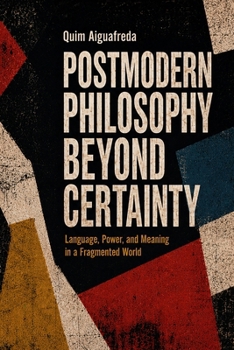
Postmodern Philosophy Beyond Certainty: Language, Power, and Meaning in a Fragmented World
No Customer Reviews

What happens when philosophy stops promising certainty? Postmodern Philosophy Beyond Certainty: Language, Power, and Meaning in a Fragmented World offers a clear, engaging account of the thinkers and ideas that transformed modern intellectual life. Beginning with the cracks that appeared in Enlightenment confidence, it traces how philosophers such as Nietzsche, Freud, Saussure, Derrida, Foucault, Lyotard, Baudrillard, Butler, Crenshaw, Said, and Habermas challenged familiar assumptions about truth, language, identity, progress, and power. The book explains complex concepts without reducing them to slogans. It explores deconstruction, discourse, genealogy, normalization, gender performativity, intersectionality, Orientalism, simulacra, hyperreality, and the distrust of grand narratives. It also distinguishes postmodernism from poststructuralism and deconstruction, while examining proposed successors such as metamodernism, remodernism, posthumanism, and post-postmodernism. Postmodern thought is taken seriously without being treated as sacred. Its strongest insights are presented alongside the objections they provoke: Does criticism of absolute truth lead to relativism? Can suspicion become politically sterile? If identities and institutions are historically constructed, how can people still make responsible judgments or act together?
Format:Paperback
Language:English
ISBN:B0H9FP1YQJ
ISBN13:9798187862580
Release Date:July 2026
Publisher:Independently Published
Length:230 Pages
Weight:0.69 lbs.
Dimensions:0.5" x 6.0" x 9.0"
Customer Reviews
0 rating
Copyright © 2026 Thriftbooks.com
Terms of Use | Privacy Policy | Do Not Sell/Share My Personal Information | Cookie Notice | Cookie Preferences | Accessibility Statement
ThriftBooks ® and the ThriftBooks ® logo are registered trademarks of Thrift Books Global, LLC
ThriftBooks ® and the ThriftBooks ® logo are registered trademarks of Thrift Books Global, LLC
