


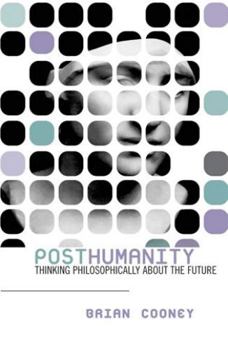
Posthumanity: Thinking Philosophically about the Future


In Posthumanity, Brian Cooney examines this philosophically turbulent era, in which the products of our latest technology will include a new kind of reality, new kinds of minds, and new sorts of bodies for those minds. Until now, major technological innovations have always had an important effect on human history. But our newest technology will alter the human animal to such an extent that the next era could end up being posthuman.
Posthumanity introduces key concepts in philosophy in a creative and provocative manner guaranteed to engage the attention of first-year students and other newcomers to the study of philosophy. Using examples from films, television, and science fiction, Cooney advances a fascinating and original argument about technology while simultaneously acquainting students with the foundations of philosophy.Format:Paperback
Language:English
ISBN:0742532933
ISBN13:9780742532939
Release Date:May 2004
Publisher:Rowman & Littlefield Publishers
Length:232 Pages
Weight:0.68 lbs.
Dimensions:0.5" x 5.8" x 8.9"
Customer Reviews
1 rating
It provokes your thinking about the future.
Published by Thriftbooks.com User , 21 years ago
I read this book because it's one of the assignments of my Communication Planning class. Personally, I don't think this book is much related to the focus of the class- futures forecasting and planning in telecommunications. However, it gives you ideas about what future may be like and invokes questions regarding how can human deal with it from 4 aspects- reality, mind, embodiment, and posthumanity. As my background is more engineering and computer science related, I found this book a bit difficult and at the same time interesting to read because it talks about "philosophies" quite a lot. But the author Brain Cooney introduced the ideas from everyday examples, for instance, the movies The Matrix and Contact. The author many times used dialogues to convey his ideas and form provoking questions at the reflection part. The book proposed many provoking questions, such as "Can artificial functional equivalents of human persons be treated as having our moral and political rights?" The author even helped reader's thinking when giving questions. For example, under the discussion of embodiment, the author asked "Would we want to say that the bionic components of our bodies are not parts of a living body because they are not composed of tissues that are assemblies of cells? Yet we say that cells are alive, even though their parts are not........ If not, can a being have a conscious mind and not be alive? Or, paradoxically, is there some nonbiological kind of "life"?" This book is about technological forecasting, especially in topics about bionic body and artificial intelligence and discusses their impacts to human from philosophy aspect by the help of some well known movies and TV programs. It's very readable for non-philosophy major students. One of the questions I like most is: "If there were any prospect of interaction with the alien civilization, would that prospect alone risk a collapse of human confidence, self-respect, and even civilization? Not necessarily, but there won't be much time to plan for the eventuality if it simply takes us by surprise sometime soon". This question highlight why we need to do futures forecasting and planning- to be prepared for the possible futures. Unless you are a philosophy major and know about technological forecasting, you will most likely find this book very interesting.
Copyright © 2026 Thriftbooks.com Terms of Use
| Privacy Policy | Do Not
Sell/Share My Personal Information | Cookie Policy | Cookie Preferences | Accessibility Statement
ThriftBooks® and the ThriftBooks® logo are registered trademarks of Thrift Books Global, LLC
ThriftBooks® and the ThriftBooks® logo are registered trademarks of Thrift Books Global, LLC
