


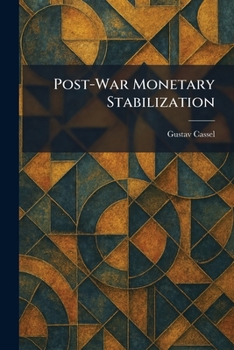
Post-War Monetary Stabilization

Select Format
Select Condition 
Book Overview
"Post-War Monetary Stabilization" is a seminal examination of the global financial landscape following the First World War, authored by the renowned economist Gustav Cassel. This work addresses the profound disruptions to the international monetary system caused by the abandonment of the gold standard and the subsequent inflationary pressures of the early 20th century.
Cassel, a leading figure in monetary theory, explores the challenges of returning to a stable gold-based currency and the necessity of international cooperation to prevent economic volatility. The text delves into the mechanisms of purchasing power parity and evaluates the efforts of various nations to restore fiscal discipline. Through rigorous analysis, Cassel argues for a more rational approach to currency management that prioritizes price stability over traditional orthodoxies.
This volume remains a critical resource for understanding the evolution of modern economic policy and the historical roots of international central banking. It offers invaluable insights into the complexities of exchange rates, the role of gold in the global economy, and the persistent quest for financial equilibrium in a post-conflict world.
This work has been selected by scholars as being culturally important, and is part of the knowledge base of civilization as we know it. This work was reproduced from the original artifact, and remains as true to the original work as possible. Therefore, you may see the original copyright references, library stamps (as most of these works have been housed in our most important libraries around the world), and other notations in the work.
This work is in the public domain in the United States of America, and possibly other nations. Within the United States, you may freely copy and distribute this work, as no entity (individual or corporate) has a copyright on the body of the work.
As a reproduction of a historical artifact, this work may contain missing or blurred pages, poor pictures, errant marks, etc. Scholars believe, and we concur, that this work is important enough to be preserved, reproduced, and made generally available to the public. We appreciate your support of the preservation process, and thank you for being an important part of keeping this knowledge alive and relevant.
Customer Reviews
ThriftBooks ® and the ThriftBooks ® logo are registered trademarks of Thrift Books Global, LLC
