


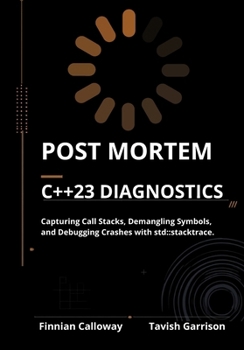
POST MORTEM C++23 DIAGNOSTICS: Capturing Call Stacks, Demangling Symbols, and Debugging Crashes with std::stacktrace. (The C++ Field Guide Series)
No Customer Reviews

A production crash with a fully resolved stack trace can still send you chasing the wrong function for an hour, because the trace is accurate and the story it's telling you is not.
Most engineers treat a resolved std:: stacktrace as ground truth: real frames, real files, real lines, case closed. Under optimization it proves far less than it looks like it does. An inlined function vanishes from the trace with no record that it was ever there. Tail call elimination hands you a caller's name for a frame that no longer exists. A trace captured inside a catch block shows you where you noticed the failure, not where it started, because the frames that mattered already unwound before you called current(). These aren't edge cases. They're the default shape of a trace pulled from any release build running at -O2.
Post Mortem C++23 Diagnostics is not an introduction to std:: stacktrace's API surface. It is a strictly technical, mechanism first field guide for systems engineers, SREs, and backend developers who already ship C++ to production and need to diagnose, not guess at, why a crash trace came back empty, wrong, or unreadable.
Through precise mechanism level reasoning, production grade code verified against real toolchains, and real diagnostic workflows, you will learn to read a trace for what it actually proves instead of what it appears to show, and to build a capture and logging pipeline that hands you a usable trace exactly when an incident needs one.
Inside the Book, You Will Diagnose and Fix:
The Empty Trace: Diagnose why a fully constructed stacktrace resolves to nothing, stripped symbols, a missing resolution backend, or one forgotten link flag, and fix each permanently instead of one incident at a time.
Traces That Lie: Recognize when an inlined function has vanished from the call chain entirely, and when tail call elimination hands you a caller that never actually called anything.
Exception Unwinding vs. Capture: Stop capturing a trace after the frames you need have already unwound, and attach it at the throw site instead, before the stack that matters is gone.
Demangling and Symbol Noise: Turn raw Itanium and MSVC mangled names into something readable under incident pressure, and control template and lambda name length before it floods your log pipeline.
The Third-Party Exception Gap: Close the real limitation in C++23, no automatic trace on exceptions you don't control, using a boundary pattern that costs nothing on the calls you didn't wrap.
The Post-Mortem Checklist: Build the one page release gate, build flags, symbol strategy, capture scoping, that turns "did this crash actually happen the way the trace says" from a guess into five minutes of verification.
Stop trusting a trace just because it printed something. Whether you're instrumenting a new service or staring at a crash report that's sat unresolved for a week, this book gives you the exact reasoning, code, and diagnostic flow to know the difference between a trace telling you the truth and one that's technically valid and quietly misleading.
Who this book is for: senior C++ engineers, SREs, and backend or infrastructure developers who already ship C++23 to production and need to move from "the trace came back empty" to actually diagnosing why, and fixing it for good. It assumes working knowledge of C++ and standard debugging concepts. It is not an introduction to stack traces or debugging for beginners.
Scroll up and click "Buy Now" to stop guessing at your next production crash.
Most engineers treat a resolved std:: stacktrace as ground truth: real frames, real files, real lines, case closed. Under optimization it proves far less than it looks like it does. An inlined function vanishes from the trace with no record that it was ever there. Tail call elimination hands you a caller's name for a frame that no longer exists. A trace captured inside a catch block shows you where you noticed the failure, not where it started, because the frames that mattered already unwound before you called current(). These aren't edge cases. They're the default shape of a trace pulled from any release build running at -O2.
Post Mortem C++23 Diagnostics is not an introduction to std:: stacktrace's API surface. It is a strictly technical, mechanism first field guide for systems engineers, SREs, and backend developers who already ship C++ to production and need to diagnose, not guess at, why a crash trace came back empty, wrong, or unreadable.
Through precise mechanism level reasoning, production grade code verified against real toolchains, and real diagnostic workflows, you will learn to read a trace for what it actually proves instead of what it appears to show, and to build a capture and logging pipeline that hands you a usable trace exactly when an incident needs one.
Inside the Book, You Will Diagnose and Fix:
The Empty Trace: Diagnose why a fully constructed stacktrace resolves to nothing, stripped symbols, a missing resolution backend, or one forgotten link flag, and fix each permanently instead of one incident at a time.
Traces That Lie: Recognize when an inlined function has vanished from the call chain entirely, and when tail call elimination hands you a caller that never actually called anything.
Exception Unwinding vs. Capture: Stop capturing a trace after the frames you need have already unwound, and attach it at the throw site instead, before the stack that matters is gone.
Demangling and Symbol Noise: Turn raw Itanium and MSVC mangled names into something readable under incident pressure, and control template and lambda name length before it floods your log pipeline.
The Third-Party Exception Gap: Close the real limitation in C++23, no automatic trace on exceptions you don't control, using a boundary pattern that costs nothing on the calls you didn't wrap.
The Post-Mortem Checklist: Build the one page release gate, build flags, symbol strategy, capture scoping, that turns "did this crash actually happen the way the trace says" from a guess into five minutes of verification.
Stop trusting a trace just because it printed something. Whether you're instrumenting a new service or staring at a crash report that's sat unresolved for a week, this book gives you the exact reasoning, code, and diagnostic flow to know the difference between a trace telling you the truth and one that's technically valid and quietly misleading.
Who this book is for: senior C++ engineers, SREs, and backend or infrastructure developers who already ship C++23 to production and need to move from "the trace came back empty" to actually diagnosing why, and fixing it for good. It assumes working knowledge of C++ and standard debugging concepts. It is not an introduction to stack traces or debugging for beginners.
Scroll up and click "Buy Now" to stop guessing at your next production crash.
Format:Paperback
Language:English
ISBN:B0HG753HFX
ISBN13:9798194364381
Release Date:August 2026
Publisher:Independently published
Length:119 Pages
Weight:0.45 lbs.
Dimensions:9.6" x 0.3" x 6.7"
Customer Reviews
0 rating
Copyright © 2026 Thriftbooks.com
Terms of Use | Privacy Policy | Do Not Sell/Share My Personal Information | Cookie Policy | Cookie Preferences | Accessibility Statement
ThriftBooks ® and the ThriftBooks ® logo are registered trademarks of Thrift Books Global, LLC
ThriftBooks ® and the ThriftBooks ® logo are registered trademarks of Thrift Books Global, LLC
