


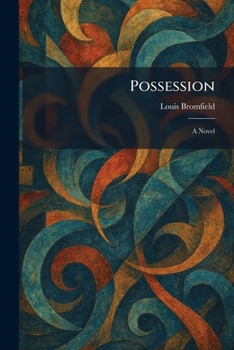
Possession

Select Format
Select Condition 
Book Overview
"Possession: A Novel" is a sweeping exploration of ambition, artistry, and the relentless pursuit of self-determination. Following the journey of Ellen Tolliver, a fiercely independent young woman born into the stifling environment of a provincial Midwestern town, the narrative traces her transformation into a celebrated international concert pianist. Driven by an insatiable desire to escape the limitations of her upbringing, Ellen navigates the complex social landscapes of New York and Europe, discovering that the path to success is often paved with sacrifice and the severance of old ties.
Louis Bromfield crafts a rich tapestry of early 20th-century life, contrasting the industrial grit of the American heartland with the sophisticated salons of Paris. As Ellen rises through the ranks of the musical world, the novel examines the psychological weight of "possession"-both the desire to own one's destiny and the ways in which individuals are possessed by their pasts, their families, and their own consuming passions. A profound character study and a vibrant social chronicle, "Possession: A Novel" remains a compelling testament to the struggle for personal autonomy in a rapidly changing world. This work stands as a cornerstone of Bromfield's literary achievement, capturing the restless spirit of an era caught between tradition and modernity.
This work has been selected by scholars as being culturally important, and is part of the knowledge base of civilization as we know it. This work was reproduced from the original artifact, and remains as true to the original work as possible. Therefore, you may see the original copyright references, library stamps (as most of these works have been housed in our most important libraries around the world), and other notations in the work.
This work is in the public domain in the United States of America, and possibly other nations. Within the United States, you may freely copy and distribute this work, as no entity (individual or corporate) has a copyright on the body of the work.
As a reproduction of a historical artifact, this work may contain missing or blurred pages, poor pictures, errant marks, etc. Scholars believe, and we concur, that this work is important enough to be preserved, reproduced, and made generally available to the public. We appreciate your support of the preservation process, and thank you for being an important part of keeping this knowledge alive and relevant.
Customer Reviews
ThriftBooks® and the ThriftBooks® logo are registered trademarks of Thrift Books Global, LLC
