


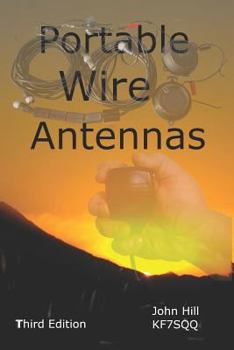
Portable Wire Antennas
No Customer Reviews

This book is written to enable a new comer to amateur radio to understand the concepts and practical considerations of wire antennas without getting lost in mathematics and complex theory. It provides clear easily understood explanations on the principles of antenna operation, transmission line considerations, impedance matching, baluns, tuners, and the pros and cons of different types and configurations of wire antennas.
Portable, reliable HF communication is required for emergency management, expedition communications and recreational uses. This book discusses the construction of portable HF wire antennas that will provide maximum performance with low power, light weight and low bulk. All the information required to assemble antennas and antenna kits that can be deployed in multiple configurations is provided. Special attention is given to wire antennas deployed at low heights above ground, a situation confronted by operators on the move. Special attention is also given to NVIS (Near Vertical Incident Skywave) communications, which is also optimum with low antenna elevation. NVIS propagation enables communications in the 50-500 mile range regardless of terrain and independent of repeaters. With one to three low suspension points (8-20 ft.), one can deploy wire antennas that cover the 160-30 meter bands (those capable of NVIS propagation) with performance optimized for NVIS communication.With a single high suspension point that can be improvised from one or two tall trees, buildings or cliff faces and one of the antenna launch systems described here, one can deploy multiple antenna options that can be configured from the modular antenna kit. These include inverted V resonant or random wire dipoles, long wire antennas, sloper dipoles and inverted L antennas for efficient all-band regional use. It also covers long wire, two suspension point rhombics, terminated V beam and inverted half rhombic beam antennas optimized for 20-10 meters while being broad band (no tuner required), low noise and gain equal to or greater than a high dipole. With two medium to high suspension points (15-80 ft. depending on the band), one can install Extended Double Zep or half square wire antennas that produce low angle radiation that is optimum for DX operation and yield 3 dBd of gain over a dipole.
Format:Paperback
Language:English
ISBN:1884979157
ISBN13:9781884979156
Release Date:September 2018
Publisher:Clear Springs Press, LLC
Length:184 Pages
Weight:0.61 lbs.
Dimensions:0.4" x 6.0" x 9.0"
Customer Reviews
0 rating
Copyright © 2026 Thriftbooks.com
Terms of Use | Privacy Policy | Do Not Sell/Share My Personal Information | Cookie Policy | Cookie Preferences | Accessibility Statement
ThriftBooks ® and the ThriftBooks ® logo are registered trademarks of Thrift Books Global, LLC
ThriftBooks ® and the ThriftBooks ® logo are registered trademarks of Thrift Books Global, LLC
