


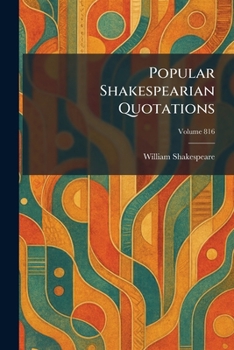
Popular Shakespearian Quotations

"Popular Shakespearian Quotations" is a curated collection of the most resonant and enduring passages from the Bard of Avon's vast body of work. This volume serves as a gateway to the wit, wisdom, and profound observations of William Shakespeare, encompassing his tragedies, comedies, histories, and sonnets. Readers will find themselves immersed in the timeless language that has shaped the English-speaking world, from the philosophical ruminations of "Hamlet" to the romantic declarations of "Romeo and Juliet."
The collection is designed to highlight the lyrical beauty and intellectual depth of Shakespeare's writing, making his most iconic lines accessible for study, public speaking, or personal reflection. By focusing on the universality of the human experience-exploring themes of love, ambition, betrayal, and mortality-this compilation demonstrates why Shakespeare remains the preeminent figure in Western literature. Whether for a scholar seeking a specific reference or a casual reader wishing to appreciate the power of iambic pentameter, "Popular Shakespearian Quotations" offers a concentrated dose of literary excellence. This anthology preserves the brilliance of Shakespearean verse and prose, ensuring that these "household words" continue to inspire and provoke thought in every generation.
This work has been selected by scholars as being culturally important, and is part of the knowledge base of civilization as we know it. This work was reproduced from the original artifact, and remains as true to the original work as possible. Therefore, you may see the original copyright references, library stamps (as most of these works have been housed in our most important libraries around the world), and other notations in the work.
This work is in the public domain in the United States of America, and possibly other nations. Within the United States, you may freely copy and distribute this work, as no entity (individual or corporate) has a copyright on the body of the work.
As a reproduction of a historical artifact, this work may contain missing or blurred pages, poor pictures, errant marks, etc. Scholars believe, and we concur, that this work is important enough to be preserved, reproduced, and made generally available to the public. We appreciate your support of the preservation process, and thank you for being an important part of keeping this knowledge alive and relevant.
Customer Reviews
ThriftBooks ® and the ThriftBooks ® logo are registered trademarks of Thrift Books Global, LLC
