
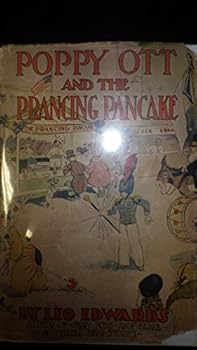
"Poppy Ott and the Prancing Pancake" is a delightful and humorous installment in the beloved series featuring the inventive and quick-witted Poppy Ott. Written by Leo Edwards, this adventure follows the titular hero as he navigates a series of whimsical mishaps and clever schemes in the small town of Tutter. Known for his ability to turn an ordinary situation into a grand enterprise, Poppy finds himself entangled in a mystery that is as eccentric as its name suggests.
This volume captures the essence of classic American boys' fiction, blending lighthearted mystery with genuine camaraderie. As Poppy and his friends work together, readers are treated to a narrative rich in local color, sharp dialogue, and the inventive problem-solving that defined the series. The story emphasizes themes of friendship, ingenuity, and the playful spirit of youth.
Enhanced by the spirit of early 20th-century storytelling, "Poppy Ott and the Prancing Pancake" remains a charming example of juvenile literature that continues to entertain with its unique blend of comedy and suspense. It is a quintessential read for those who enjoy classic tales of youthful ambition and small-town high jinks.
This work has been selected by scholars as being culturally important, and is part of the knowledge base of civilization as we know it. This work was reproduced from the original artifact, and remains as true to the original work as possible. Therefore, you may see the original copyright references, library stamps (as most of these works have been housed in our most important libraries around the world), and other notations in the work.
This work is in the public domain in the United States of America, and possibly other nations. Within the United States, you may freely copy and distribute this work, as no entity (individual or corporate) has a copyright on the body of the work.
As a reproduction of a historical artifact, this work may contain missing or blurred pages, poor pictures, errant marks, etc. Scholars believe, and we concur, that this work is important enough to be preserved, reproduced, and made generally available to the public. We appreciate your support of the preservation process, and thank you for being an important part of keeping this knowledge alive and relevant.

