


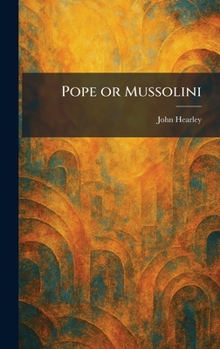
Pope or Mussolini

"Pope or Mussolini" by John Hearley is a compelling contemporary analysis of the complex and often contentious relationship between the Vatican and the burgeoning Fascist state in Italy during the late 1920s. Written at a pivotal moment in history, the work explores the ideological and political struggle for dominance between the spiritual authority of the Catholic Church and the authoritarian ambitions of Benito Mussolini. Hearley delves into the intricacies of the tensions inherent in a nation divided between religious loyalty and nationalistic fervor.
The narrative examines how the interaction between the papacy and the Italian state influenced both domestic policy and broader international relations. Through a detailed examination of the key players and their conflicting visions for the future of Italy, "Pope or Mussolini" offers readers a profound look at the intersection of faith and political power. This historical study captures the atmosphere of a transformative era, providing essential insights into the rise of Fascism and its impact on one of the world's most influential religious institutions. It remains a significant resource for those interested in European political history and the evolution of Church-State relations in the twentieth century.
This work has been selected by scholars as being culturally important, and is part of the knowledge base of civilization as we know it. This work was reproduced from the original artifact, and remains as true to the original work as possible. Therefore, you may see the original copyright references, library stamps (as most of these works have been housed in our most important libraries around the world), and other notations in the work.
This work is in the public domain in the United States of America, and possibly other nations. Within the United States, you may freely copy and distribute this work, as no entity (individual or corporate) has a copyright on the body of the work.
As a reproduction of a historical artifact, this work may contain missing or blurred pages, poor pictures, errant marks, etc. Scholars believe, and we concur, that this work is important enough to be preserved, reproduced, and made generally available to the public. We appreciate your support of the preservation process, and thank you for being an important part of keeping this knowledge alive and relevant.
Related Subjects
History Political Science Politics & Social Sciences Religion Religion & SpiritualityCustomer Reviews
ThriftBooks ® and the ThriftBooks ® logo are registered trademarks of Thrift Books Global, LLC
