


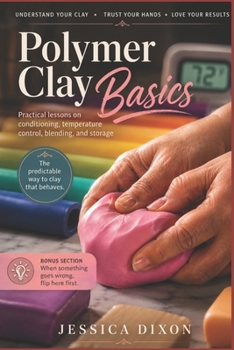
Polymer Clay Basics: Practical lessons on conditioning, temperature control, blending, and storage
No Customer Reviews

The Simple Polymer Clay Book That Actually Explains What Tutorials Skip
Does your polymer clay feel like a brick no matter how long you knead it?
Do your color blends keep turning into muddy gray sludge instead of smooth gradients?
And when you finally bake something, does it crack, darken, or come out wrong without any clue why?
Most beginner guides show beautiful finished projects. They skip the invisible problems. The clay that refuses to soften. The room temperature that secretly ruins your session. The storage mistake that destroys your entire stash while you're not looking. This book is different.
Polymer clay has four hidden variables that control every single thing you make. Conditioning. Temperature. Blending. Storage. When you don't understand how they interact, the craft feels like luck. One day your piece works beautifully. The next day the same steps fall apart. You start wondering if you're just not talented enough.
You are not the problem. You were just never taught how these four pieces connect.
This book walks you through each one, in the exact order you need, without art school language or assumptions about what you already know. You'll learn why your clay behaves the way it does, what to do when it won't cooperate, and how to stop wasting materials on mistakes you don't understand. Inside, you'll find: How to condition stiff clay without wrecking your hands, even if you have arthritis or weak gripWhy your clay feels completely different from one day to the next, and the simple temperature fix most tutorials never mentionHow to rescue sticky or crumbly clay you thought was beyond savingThe exact folding technique that builds smooth color blends without creating mudWhich color combinations to avoid so you stop wasting clay on bad mixesA complete storage system that keeps your clay workable for months, adapted for any climateHow to bake your pieces so they come out strong, not scorched or crackedA full troubleshooting guide organized by symptom so you can find answers fast while workingYou don't need expensive tools. You don't need natural talent. You need someone to explain the fundamentals clearly, in plain language, with room to make mistakes along the way.
Every experienced polymer clay artist started with cracked pieces and muddy colors. The ones who kept going simply learned what this book teaches: how to read your clay, control your conditions, and trust your hands.
I wrote this book because I remember what it felt like to open a package of clay full of excitement, only to feel defeated an hour later. Nothing worked the way tutorials promised. I blamed myself. Later I realized the information I needed wasn't missing, it was just never explained in a way that made sense for someone starting from zero. This book is the guide I wish I'd had.
At the end, I've included an optional bonus troubleshooting reference you can keep beside your workspace. The main book is complete on its own, the bonus is simply there for extra support when you need a quick answer.
Your clay can behave predictably. Your blends can look clean. Your pieces can bake without cracking. You just need the right foundation. Start here.
Does your polymer clay feel like a brick no matter how long you knead it?
Do your color blends keep turning into muddy gray sludge instead of smooth gradients?
And when you finally bake something, does it crack, darken, or come out wrong without any clue why?
Most beginner guides show beautiful finished projects. They skip the invisible problems. The clay that refuses to soften. The room temperature that secretly ruins your session. The storage mistake that destroys your entire stash while you're not looking. This book is different.
Polymer clay has four hidden variables that control every single thing you make. Conditioning. Temperature. Blending. Storage. When you don't understand how they interact, the craft feels like luck. One day your piece works beautifully. The next day the same steps fall apart. You start wondering if you're just not talented enough.
You are not the problem. You were just never taught how these four pieces connect.
This book walks you through each one, in the exact order you need, without art school language or assumptions about what you already know. You'll learn why your clay behaves the way it does, what to do when it won't cooperate, and how to stop wasting materials on mistakes you don't understand. Inside, you'll find: How to condition stiff clay without wrecking your hands, even if you have arthritis or weak gripWhy your clay feels completely different from one day to the next, and the simple temperature fix most tutorials never mentionHow to rescue sticky or crumbly clay you thought was beyond savingThe exact folding technique that builds smooth color blends without creating mudWhich color combinations to avoid so you stop wasting clay on bad mixesA complete storage system that keeps your clay workable for months, adapted for any climateHow to bake your pieces so they come out strong, not scorched or crackedA full troubleshooting guide organized by symptom so you can find answers fast while workingYou don't need expensive tools. You don't need natural talent. You need someone to explain the fundamentals clearly, in plain language, with room to make mistakes along the way.
Every experienced polymer clay artist started with cracked pieces and muddy colors. The ones who kept going simply learned what this book teaches: how to read your clay, control your conditions, and trust your hands.
I wrote this book because I remember what it felt like to open a package of clay full of excitement, only to feel defeated an hour later. Nothing worked the way tutorials promised. I blamed myself. Later I realized the information I needed wasn't missing, it was just never explained in a way that made sense for someone starting from zero. This book is the guide I wish I'd had.
At the end, I've included an optional bonus troubleshooting reference you can keep beside your workspace. The main book is complete on its own, the bonus is simply there for extra support when you need a quick answer.
Your clay can behave predictably. Your blends can look clean. Your pieces can bake without cracking. You just need the right foundation. Start here.
Format:Paperback
Language:English
ISBN:B0H6KZ79Z9
ISBN13:9798180850522
Release Date:June 2026
Publisher:Independently Published
Length:44 Pages
Weight:0.16 lbs.
Dimensions:0.1" x 6.0" x 9.0"
Customer Reviews
0 rating
Copyright © 2026 Thriftbooks.com
Terms of Use | Privacy Policy | Do Not Sell/Share My Personal Information | Cookie Policy | Cookie Preferences | Accessibility Statement
ThriftBooks ® and the ThriftBooks ® logo are registered trademarks of Thrift Books Global, LLC
ThriftBooks ® and the ThriftBooks ® logo are registered trademarks of Thrift Books Global, LLC
