


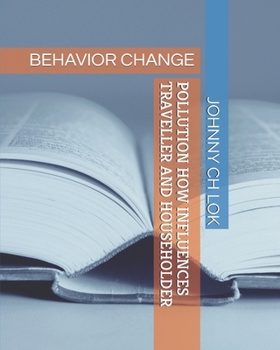
Pollution How Influences Traveller and Householder: Behavior Change
No Customer Reviews

In fact, energy consumption, environmental protection and economic growth belong to an organic whole. The development of industry plays an important part in the development of the national economy. Meanwhile the development of industry spends lots of energy and makes serious pollution. Energy is a important material basis of human survival, economic development and social progress. Instance, China is promoting energy production and sustainable economic growth. We know that the environmental pollution should be the cost of economic development. Energy consumption and environmental pollution in-depth has a great practical significance for guiding the healthy development of China's economy.The sustainable economic growth, urbanization and environmental protection in China. China has developed to become the second largest economy in the world next to USA. With fact economic growth, cities in China have been expanding and it is through urbanization to cause serious environmental problems, such as pollution of air, water and solid waste, which have imposed huge challenges to economic growth. In fact, urbanization has led to damage to the environment. So, the China environmental pollution is caused from the relationship between economic development and urbanization and then urbanization is driving economic growth. Also, the major environmental pollution is driving to China's economic growth and the major environmental problems of China are caused by urbanization in China and urbanization will cause negative consequences. However, China industrialization demands are increasing and China economic growth is also increasing, but the environment pollution is also increasing at the same time. Another environmental pollution of country, such as Australia, its economy has grown an average of 3.3 % gross domestic product (GDP) annually the past 40 years, corresponding to an average annual GDP per capita growth rate of 1.3% (ABS, 2014). There are concerns that growth has been accompanied by excessive natural resource use and declines in environmental quality. However, economic growth can also stimulate demand for environmental quality and thus environmental policy has been enabling the development and adoption of new technologies. Whether income growth is associated with increasing or decreasing environmental quality issue for long term, which is a question that varies across environmental quality measures and economies growth. The fact is as the scale of Australia economic activity increase, environmental degradation, including increasing resource use and negative externalities tends to increase as well. On the one hand, econometricians indicated that "starting in the early 1990 year highlights the possibility that for some environmental pollutants there tends to be an inverted "U" shaped development path with respect to income, as measured by GDP, such that pollution tends to after some switching point ( Grossman and Krueger, 1991)." This relationship could arise from demand side pressures ( environmental quality is a normal product) or supply side pressures ( technological and structural changes) . It is possible to bring the relationship between environmental quality and economic growth. On the other hand, nowadays, the conflict between economic growth and biodiversity conservation is concerned from many countries' governments. A more compelling response to the conflict is that may be resolved with technological progress. However, I review the conflict between economic growth and biodiversity conservation in the absence of technological progress. The conflict between economic growth and biodiversity conservation is based principle of ecology, such as trophic levels and competitive exclusion, the human economy grows at the competitive exclusion of nonhuman species in the aggregate.
Format:Paperback
Language:English
ISBN:B08QDYPSMT
ISBN13:9798580529967
Release Date:January 1
Publisher:Independently Published
Length:238 Pages
Weight:1.46 lbs.
Dimensions:0.6" x 8.0" x 10.0"
Customer Reviews
0 rating
Copyright © 2026 Thriftbooks.com Terms of Use
| Privacy Policy | Do Not
Sell/Share My Personal Information | Cookie Policy | Cookie Preferences | Accessibility Statement
ThriftBooks® and the ThriftBooks® logo are registered trademarks of Thrift Books Global, LLC
ThriftBooks® and the ThriftBooks® logo are registered trademarks of Thrift Books Global, LLC
