


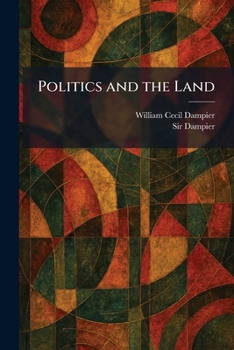
Politics and the Land

"Politics and the Land" examines the complex relationship between the British state and the agricultural sector during a period of significant economic transition in the early twentieth century. Written by Sir William Cecil Dampier, this work provides a scholarly analysis of land ownership, the financial pressures on farming, and the legislative attempts to regulate or reform rural production.
The book explores the socio-economic challenges faced by landowners and tenants alike, addressing the viability of smallholdings, the impact of taxation, and the shifting dynamics of the rural labor market. By situating agricultural issues within the broader context of national policy, Dampier offers a critical perspective on how governance affects the foundational industry of the countryside. This volume serves as an essential resource for those interested in the history of economic thought, agricultural science, and the political shifts that defined the British landscape between the world wars. "Politics and the Land" remains a significant contribution to the study of rural sociology and the evolution of agricultural policy.
This work has been selected by scholars as being culturally important, and is part of the knowledge base of civilization as we know it. This work was reproduced from the original artifact, and remains as true to the original work as possible. Therefore, you may see the original copyright references, library stamps (as most of these works have been housed in our most important libraries around the world), and other notations in the work.
This work is in the public domain in the United States of America, and possibly other nations. Within the United States, you may freely copy and distribute this work, as no entity (individual or corporate) has a copyright on the body of the work.
As a reproduction of a historical artifact, this work may contain missing or blurred pages, poor pictures, errant marks, etc. Scholars believe, and we concur, that this work is important enough to be preserved, reproduced, and made generally available to the public. We appreciate your support of the preservation process, and thank you for being an important part of keeping this knowledge alive and relevant.
Customer Reviews
ThriftBooks ® and the ThriftBooks ® logo are registered trademarks of Thrift Books Global, LLC
