


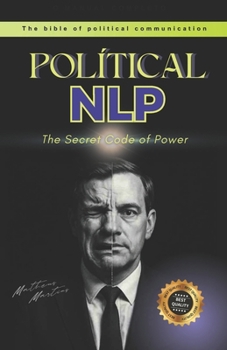
Political NLP: The Secret Code of Power

I'll tell you a secret that few dare reveal in public: the most effective politicians, the ones who truly leave a mark, are not necessarily the most intelligent, nor the most technical, nor even the most honest. They are the most influential. And influence, my dear reader, is neither a divine gift nor a genetic coincidence. It is, in large part, a science applied to communication. What if this science had a name? Well, it does: it's called Neurolinguistic Programming, or NLP for those in the know.
Now, if you were expecting a cold, academic introduction, I'm sorry to disappoint. I won't bombard you with formulas or plasticized definitions. I want you to understand this as a conversation you'd have with a seasoned politician-but not the cynical old one who plays dirty. I'm talking about someone who has discovered the invisible formula behind the speeches that send shivers down your spine, the words that hypnotize entire auditoriums, the gestures that calm angry crowds. Because yes, there is a formula. And if you learn to see it, you'll be light years ahead of most.
You know, it took me a while to understand the true power of NLP. At first, I thought it was just a bunch of techniques to "sound convincing." Coaching nonsense. Only after I saw-with my own eyes-a politician turn an entire debate in his favor with a single, well-structured sentence did I realize: it wasn't luck. It was engineering. Linguistics applied to the human brain. It was raw NLP, shining silently in the heart of the political arena.
NLP, in essence, is an instruction manual for operating the brain-not just your own, but others' as well. Imagine the human mind as software. NLP is the code. What you say, how you say it, the tone, the accompanying gesture, the breath between words-all of this enters your interlocutor's mind as invisible commands. Sounds like witchcraft? Maybe. But it's neuroscience disguised as bar talk.
And politics, as you well know, is made of this: encounters, glances, phrases that inflame or pacify. Of votes that are born not on the platform, but in the imperceptible gap between emotion and language. That's where NLP comes in: in this limbo, in that subtle gap between what is heard and what is felt.
Customer Reviews
ThriftBooks® and the ThriftBooks® logo are registered trademarks of Thrift Books Global, LLC
