


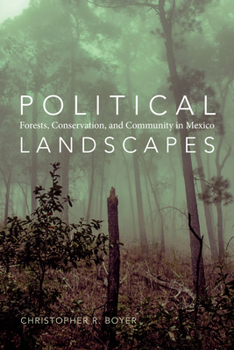
Political Landscapes: Forests, Conservation, and Community in Mexico
No Customer Reviews

Select Format
Select Condition 
Book Overview
Following the 1917 Mexican Revolution inhabitants of the states of Chihuahua and Michoac n received vast tracts of prime timberland as part of Mexico's land redistribution program. Although locals gained possession of the forests, the federal government retained management rights, which created conflict over subsequent decades among rural, often indigenous villages; government; and private timber companies about how best to manage the forests. Christopher R. Boyer examines this history in Political Landscapes, where he argues that the forests in Chihuahua and Michoac n became what he calls "political landscapes"-that is, geographies that become politicized by the interactions between opposing actors-through the effects of backroom deals, nepotism, and political negotiations. Understanding the historical dynamic of community forestry in Mexico is particularly critical for those interested in promoting community involvement in the use and conservation of forestlands around the world. Considering how rural and indigenous people have confronted, accepted, and modified the rationalizing projects of forest management foisted on them by a developmentalist state is crucial before community management is implemented elsewhere.
Format:Paperback
Language:English
ISBN:0822358328
ISBN13:9780822358329
Release Date:May 2015
Publisher:Duke University Press
Length:360 Pages
Weight:1.10 lbs.
Dimensions:0.7" x 6.5" x 8.8"
Customer Reviews
0 rating
Copyright © 2026 Thriftbooks.com Terms of Use
| Privacy Policy | Do Not
Sell/Share My Personal Information | Cookie Policy | Cookie Preferences | Accessibility Statement
ThriftBooks® and the ThriftBooks® logo are registered trademarks of Thrift Books Global, LLC
ThriftBooks® and the ThriftBooks® logo are registered trademarks of Thrift Books Global, LLC
