


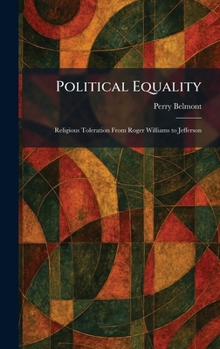
Political Equality: Religious Toleration From Roger Williams to Jefferson

"Political Equality: Religious Toleration From Roger Williams to Jefferson" is an insightful historical exploration of the evolution of religious freedom as a fundamental pillar of American democracy. Written by Perry Belmont, this work traces the conceptual development of toleration from its early colonial roots in the convictions of Roger Williams to its eventual codification through the efforts of Thomas Jefferson and the founding generation.
The book examines the intricate relationship between religious liberty and civic rights, arguing that the struggle for religious toleration was inextricably linked to the broader pursuit of political equality. By analyzing the transition from state-mandated religion to a system of voluntary conscience, Belmont highlights the philosophical shifts that allowed the United States to emerge as a pioneer in secular governance. The narrative focuses on the legal and social challenges faced by early advocates of liberty, illustrating how their persistence shaped the American constitutional framework.
This study serves as a vital resource for understanding the historical debates surrounding the separation of church and state. It provides a clear account of how the principle of equality before the law was extended to include spiritual life, ensuring that religious identity would no longer dictate a citizen's political status. Belmont's analysis remains a significant contribution to the study of American political theory and the history of civil liberties.
This work has been selected by scholars as being culturally important, and is part of the knowledge base of civilization as we know it. This work was reproduced from the original artifact, and remains as true to the original work as possible. Therefore, you may see the original copyright references, library stamps (as most of these works have been housed in our most important libraries around the world), and other notations in the work.
This work is in the public domain in the United States of America, and possibly other nations. Within the United States, you may freely copy and distribute this work, as no entity (individual or corporate) has a copyright on the body of the work.
As a reproduction of a historical artifact, this work may contain missing or blurred pages, poor pictures, errant marks, etc. Scholars believe, and we concur, that this work is important enough to be preserved, reproduced, and made generally available to the public. We appreciate your support of the preservation process, and thank you for being an important part of keeping this knowledge alive and relevant.
Related Subjects
History Political Science Politics & Social Sciences Religion Religion & SpiritualityCustomer Reviews
ThriftBooks ® and the ThriftBooks ® logo are registered trademarks of Thrift Books Global, LLC
