


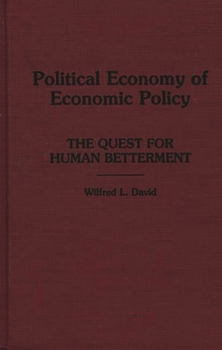
Political Economy of Economic Policy: The Quest for Human Betterment
No Customer Reviews

David takes as his point of departure the orthodox rational paradigm of public policy-making--which, he argues, does not adequately reflect real-world process--to present an integrated model for economic policy formulation and execution. By juxtaposing the theoretical foundations of the rationalist model with insights drawn from alternative systems of political economy, he shows how economic decisionmaking is both more complex and less idealistic than the rational paradigm assumes. In constructing his argument, David systematically integrates ideas drawn from moral philosophy, politics, sociology, systems theory, institutional and neo-Marxian economic thought, and international dimensions of poitical economy. He suggests a reorientation of theory and analysis based on an approach emphasizing the role of values, conflicts, power, and divergent interests in the decisionmaking process. Focusing throughout on questions raised by the rationalist model, David builds his analysis around issues such as: the validity of the dominant theories of public economic decision-making; the logical vis-a-vis ideological foundations of economic policy postulates; the extent to which decisions can be made more responsive to values pertaining to human development.
Format:Hardcover
Language:English
ISBN:0275930157
ISBN13:9780275930158
Release Date:September 1988
Publisher:Praeger
Length:286 Pages
Weight:1.27 lbs.
Dimensions:0.7" x 6.1" x 9.2"
Customer Reviews
0 rating
Copyright © 2026 Thriftbooks.com Terms of Use
| Privacy Policy | Do Not
Sell/Share My Personal Information | Cookie Policy | Cookie Preferences | Accessibility Statement
ThriftBooks® and the ThriftBooks® logo are registered trademarks of Thrift Books Global, LLC
ThriftBooks® and the ThriftBooks® logo are registered trademarks of Thrift Books Global, LLC
