


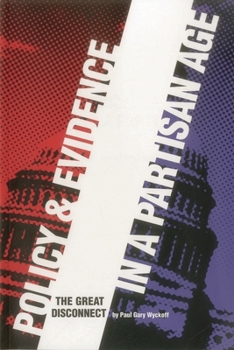
Policy and Evidence in a Partisan Age: The Great Disconnect


With the warring between left and right, Democrats and Republicans, advocacy groups on one side and advocacy groups on the other, it seems as if those who set our national agenda are those who shout the loudest. But shouldn't scholarship count for more than preconceived notions? Policy and Evidence in a Partisan Age debunks myths about economic and social policy while explaining the standards of evidence that should guide our legislation. Author Paul Gary Wyckoff also recommends revisions to economics and law curricula so that the next generation of legislators will know how to craft evidence-based policy derived from research rather than conventional wisdom and theory.
Format:Paperback
Language:English
ISBN:0877667497
ISBN13:9780877667490
Release Date:May 2009
Publisher:Bloomsbury Publishing USA
Length:168 Pages
Weight:0.51 lbs.
Dimensions:0.4" x 6.0" x 9.0"
Customer Reviews
1 rating
Making Better Policy
Published by Thriftbooks.com User , 16 years ago
This is an admirably brief, clear and interesting argument for better use of evidence in policy debates. General readers, legislators, policy makers and students should all find it both readable and eye-opening. Many policy issues have obviously not been the subject of clear empirical studies. But politicians (on both left and right) often base their decisions solely on ideology, failing to evaluate evidence appropriately even where it does exist. Wyckoff attributes some of this tendency to the theoretical bent of economics departments and the lack of statistical training in law schools. He makes a number of practical suggestions for curricular reform. In pursuing his larger argument, Wyckoff also offers a good deal of evidence to suggest that much of what politicians promise may be unattainable. Government may not actually be able to do much to create jobs or stimulate the economy, and attempts to change people's behavior through government policies have been largely unsuccessful. One might quibble with some of these points (he does not address the anti-smoking campaign, which appears to have had some success over the past 30 years), but the general case is compelling. Wyckoff's attempt to position himself in the center of the ideological spectrum may seem disingenuous to those conservatives who reject all social policy as liberal meddling, and his critical analyses of various policy projects will certainly annoy those liberals who support them. But if we want to make effective social policy, Wyckoff argues that we should try to figure out what actually works.
Copyright © 2026 Thriftbooks.com
Terms of Use | Privacy Policy | Do Not Sell/Share My Personal Information | Cookie Policy | Cookie Preferences | Accessibility Statement
ThriftBooks ® and the ThriftBooks ® logo are registered trademarks of Thrift Books Global, LLC
ThriftBooks ® and the ThriftBooks ® logo are registered trademarks of Thrift Books Global, LLC
