


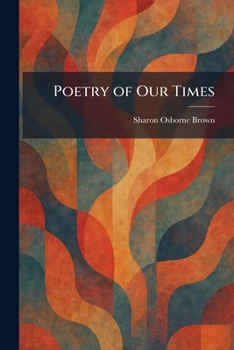
Poetry of Our Times

"Poetry of Our Times", edited by Sharon Osborne Brown, offers a compelling window into the literary landscape of the early 20th century. This expansive anthology curates a diverse selection of verse, capturing the profound shifts in poetic expression that defined the post-World War I era. As traditional structures met the rising tide of modernism, this collection serves as a vital record of the period's aesthetic evolution.
The work features a wide array of themes, ranging from the introspective and pastoral to the gritty realities of an increasingly industrial and urban world. By bringing together various voices, the anthology explores the human condition through a lens of change, uncertainty, and renewal. It is an essential volume for readers interested in the development of modern verse and the historical context of 1920s literature.
Sharon Osborne Brown provides a curated experience that highlights the technical innovation and emotional depth of her contemporaries. "Poetry of Our Times" remains a significant academic and artistic resource, preserving the creative pulse of an era that reshaped the boundaries of language and rhythm.
This work has been selected by scholars as being culturally important, and is part of the knowledge base of civilization as we know it. This work was reproduced from the original artifact, and remains as true to the original work as possible. Therefore, you may see the original copyright references, library stamps (as most of these works have been housed in our most important libraries around the world), and other notations in the work.
This work is in the public domain in the United States of America, and possibly other nations. Within the United States, you may freely copy and distribute this work, as no entity (individual or corporate) has a copyright on the body of the work.
As a reproduction of a historical artifact, this work may contain missing or blurred pages, poor pictures, errant marks, etc. Scholars believe, and we concur, that this work is important enough to be preserved, reproduced, and made generally available to the public. We appreciate your support of the preservation process, and thank you for being an important part of keeping this knowledge alive and relevant.
Customer Reviews
ThriftBooks ® and the ThriftBooks ® logo are registered trademarks of Thrift Books Global, LLC
