
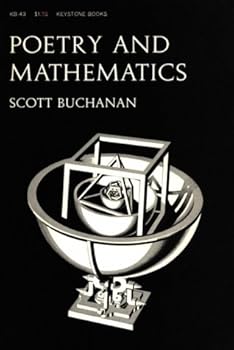
"Poetry and Mathematics" is an intellectual tour de force that explores the profound and often surprising parallels between the language of the poet and the logic of the mathematician. Scott Buchanan, a distinguished philosopher and educator, presents a compelling argument that both disciplines are fundamentally symbolic systems designed to capture and structure human experience. Rather than viewing them as opposing fields-one emotional and the other cold-Buchanan demonstrates how they share a common heritage in classical logic and the search for universal truths.
The work examines the architecture of metaphors and the symmetry of mathematical equations, revealing how both rely on structural relations to convey meaning. By analyzing the historical development of these fields from antiquity to the early 20th century, "Poetry and Mathematics" offers a holistic perspective on the human intellect. It challenges the modern fragmentation of knowledge, advocating for a return to a more integrated understanding of science and the liberal arts. This study is an essential resource for readers interested in the philosophy of science, the nature of symbolism, and the aesthetic foundations of rational thought. Buchanan's clear and insightful prose invites the reader to see the inherent beauty in numbers and the rigorous precision in verse.
This work has been selected by scholars as being culturally important, and is part of the knowledge base of civilization as we know it. This work was reproduced from the original artifact, and remains as true to the original work as possible. Therefore, you may see the original copyright references, library stamps (as most of these works have been housed in our most important libraries around the world), and other notations in the work.
This work is in the public domain in the United States of America, and possibly other nations. Within the United States, you may freely copy and distribute this work, as no entity (individual or corporate) has a copyright on the body of the work.
As a reproduction of a historical artifact, this work may contain missing or blurred pages, poor pictures, errant marks, etc. Scholars believe, and we concur, that this work is important enough to be preserved, reproduced, and made generally available to the public. We appreciate your support of the preservation process, and thank you for being an important part of keeping this knowledge alive and relevant.

