


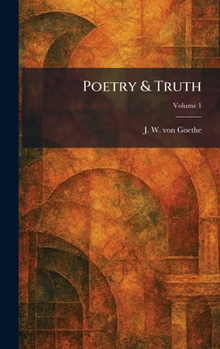
Poetry & Truth

"Poetry & Truth" is the celebrated autobiography of Johann Wolfgang von Goethe, one of the most influential figures in world literature. In this expansive work, Goethe recounts the formative years of his life, blending factual recollection with the creative interpretation of his own development. This first volume captures the author's childhood in Frankfurt, his education, and his early ventures into the worlds of law and literature.
Through evocative prose, Goethe explores the intellectual and social landscapes of eighteenth-century Germany, offering profound insights into the "Sturm und Drang" movement and the cultural shifts of his era. The narrative is not merely a chronological account but a philosophical reflection on the forces that shape a human life and a poetic genius. Readers will find detailed accounts of his family dynamics, his early loves, and the burgeoning interests that would eventually produce masterpieces like "The Sorrows of Young Werther" and "Faust." As a foundational text of German literature, "Poetry & Truth" provides an indispensable look at the man behind the myths, charting the journey of a mind that bridged the gap between the Enlightenment and Romanticism.
This work has been selected by scholars as being culturally important, and is part of the knowledge base of civilization as we know it. This work was reproduced from the original artifact, and remains as true to the original work as possible. Therefore, you may see the original copyright references, library stamps (as most of these works have been housed in our most important libraries around the world), and other notations in the work.
This work is in the public domain in the United States of America, and possibly other nations. Within the United States, you may freely copy and distribute this work, as no entity (individual or corporate) has a copyright on the body of the work.
As a reproduction of a historical artifact, this work may contain missing or blurred pages, poor pictures, errant marks, etc. Scholars believe, and we concur, that this work is important enough to be preserved, reproduced, and made generally available to the public. We appreciate your support of the preservation process, and thank you for being an important part of keeping this knowledge alive and relevant.
Customer Reviews
ThriftBooks ® and the ThriftBooks ® logo are registered trademarks of Thrift Books Global, LLC
