


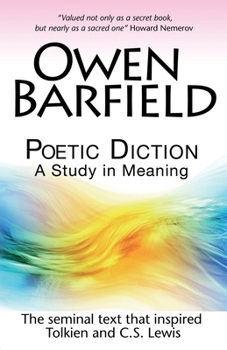
Poetic Diction: A Study in Meaning

Select Format
Select Condition 
Book Overview
Barfield discusses poetry's meaning in terms of both his personal experience and objective standards of criticism.Poetic Diction, first published in 1928, begins by asking why we call a given grouping... This description may be from another edition of this product.
Format:Paperback
Language:English
ISBN:0955958245
ISBN13:9780955958243
Release Date:February 2010
Publisher:Barfield Press UK
Length:244 Pages
Weight:0.90 lbs.
Dimensions:0.6" x 5.5" x 8.5"
Customer Reviews
5 ratings
Great Read
Published by Thriftbooks.com User , 17 years ago
This was a challenging read, but worth the effort. Barfield does a good job of showing how meaning is found in poetry. I especially liked his analysis of the word "ruin" as he traced its usage throughout history.
Wonderful, and not at all outdated!
Published by Thriftbooks.com User , 19 years ago
One of the reviewers here called Barfield 'a product of his time' and suggested that now he's useful only for practical use, not for contemporary scientists and theorists. I have to disagree, and that's why I'm writing this review. 1) Barfield's views on co-evolution of language and consciousness may not be widely accepted today, but surely they're not 'outdated'. His is simply an alternative theory of language history, and 'alternative' doesn't mean 'wrong'. It isn't 'naive' either: he only notes some rules at work in different languages (such as the tendency to greater abstraction), and applies them to poetry. Nowhere does he regard the metahistory of language as linear, and nowhere does he speak of 'primitive' times, or of evolution towards greater complexity in language, etc. 2) Barfield's theory of metaphor is very stimulating and not at all discredited today. Maybe the former reviewer read too much Donald Davidson who regards Barfield's theory invalid, but for example Paul Ricoeur often cites Barfield approvingly. So it's all a matter of scientific paradigm one works in. I could go on forever, but it'd be better if you didn't trust anyone and simply read some Barfield. Don't read him with 'a priori' knowledge of his being outdated - simply read and evaluate his every argument for yourself to see if it's valid. Theories come and go, but thoughtful books remain.
A profound contemplation on poetry, language, & meaning
Published by Thriftbooks.com User , 27 years ago
This is the first of many books by the recently deceased Mr. Barfield. It is jam-packed with wise observations relating to the intersection of poetry, language, and meaning. His arguments revolve around the metaphysical nature of metaphor, with lots of examples and subtle distinctions. In the end, the reader leaves with a vision of how a more conscious understanding and use of poetry - or better said, imaginative language - is at the heart of a true understanding of what makes us human. Let's hope lots of people order this book and that some of Barfield's other books get back into print (e.g., What Coleridge Thought, Romanticism Comes of Age).
Forgotten Classic..70 years ahead of its Time!
Published by Thriftbooks.com User , 29 years ago
This book...along with a very few others (like Marshall McLuhan's UNDERSTANDING MEDIA)...deserves its reputation as an underground classic treasured by all those who take a serious interest in Language Studies. Barfield's insights into the deep structure of metaphors as the real engine of a given language's history are only now being studied in laboratories dedicated to mapping language functions in the human brain. It has been kept in print for 50 years (well beyond the lifespan of similar books on philosophy and linguistics of its time) for one reason...it has been passed on from teachers to students as a ritual gift that has the power to shatter a mind and transform its understanding of its own workings. It will still be read when the next millenium ends
For those who write, this book is a must.
Published by Thriftbooks.com User , 29 years ago
This is more a recommendation than a review. For those of us who write, and those who read intensely, this book probes and challenges, threatens and loves. Mr Barfield, by the most lucid use of words, describes the differences between poetic and aesthetic, the idea and profundities of metaphor, the reality of translation, ( that exact translation does not exist, as an extention of the difference between definition and meaning), etc. etc. The author is sincerely inspired, which his own writing expresses with the joy of "the insect" admiring " the leaf". If you can read my humble recommendation, read this book. Martin Goldman San Juan, Puerto Ric
Copyright © 2026 Thriftbooks.com
Terms of Use | Privacy Policy | Do Not Sell/Share My Personal Information | Cookie Policy | Cookie Preferences | Accessibility Statement
ThriftBooks ® and the ThriftBooks ® logo are registered trademarks of Thrift Books Global, LLC
ThriftBooks ® and the ThriftBooks ® logo are registered trademarks of Thrift Books Global, LLC
