


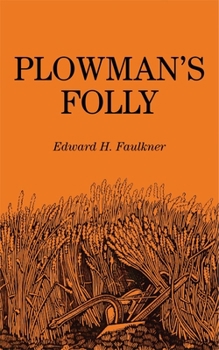
Plowman's Folly

Select Format
Select Condition 
Book Overview
It may be an overstatement to say that this book changed the face of American agriculture, but it comes very close to the truth. In the third of a century since its original publication the disk harrow has largely replaced the moldboard plow in agriculture. Mr. Faulkner's once startling, heretical doctrine-that the organic stuff of a season's crops should g back into the upper surfaces of the soil, not at the level of the plowsole of the almost universally used moldboard-has received widespread acceptance. "The fact is, said Mr. Faulkner, "that no one has ever advanced a scientific reason for plowing." With that key sentence he opened a new era in farming. He proved rather conclusively that soil impoverishment, erosion, decreasing crop yields, and many of the adverse effects following droughts or periods of excessive rainfall could be traced directly to the practice of plowing fertilizers deep into the soil. By incorporating green manures into the surface, he transformed ordinary even inferior, soils extremely productive, high-yield croplands. Plowman's Folly has gone through many printings in countries around the world-it is estimated that more than half a million copies have been printed. Time magazine called it "one of the most revolutionary ideas in agricultural history." "Here is indeed an unorthodox, and optimistic and a thought provoking book. . ." -New York Times. "An extraordinary phenomenon in American farm history. . . has been the furor over Edward H. Faulkner's Plowman's Folly. . ."-Harper's Magazine. Edward H. Faulkner lived in Elyria, Ohio, the scene of his epic experiments. He was a county agent in Kentucky and Ohio, a Smith-Hughes teacher of agriculture and a soil and crop investigator in private employment. He wrote several other books, including Soil Development and Uneasy Money, both published by the University of Oklahoma Press. Savoie Lottinville was director of the University of Oklahoma Press when Plowman's Folly was originally published.
Format:Paperback
Language:English
ISBN:0806111690
ISBN13:9780806111698
Release Date:February 2012
Publisher:University of Oklahoma Press
Length:174 Pages
Weight:0.48 lbs.
Dimensions:0.6" x 5.0" x 7.9"
Customer Reviews
4 ratings
Ground Breaking
Published by Thriftbooks.com User , 15 years ago
Today, plowing is still part of the regiment of conventional farming, but since The Plowman's Folly we have made strides toward minimum tillage or organic incorporation; examples of this are no-till gardening, mulching, and organic no till. For its day, this book and the idea of following nature was rare, and while reading this book I heard echoes of books like Salad Bar Beef and The Natural House, anything written much later that advocates working with nature rather than against it. The basic practice described in this book is to disk a cover crop like rye, incorporating it into the soil or as close to it as possible, planting seeds or transplants in rows, and covering them with some dirt. The organic matter holds water close to the surface, moderates temperature, reduces evaporation, and controls weeds. Although he didn't know it, Faulkner also explained carbon sequestration, now touted as a big benefit of no till. After reading this book, no-tillage--if you have an imagination--can be applied without purchasing multi-thousand dollar equimpent that weighs thousands of pounds so coulters can penetrate the soil. There are some downsides, however: No pictures--By the 1940s you'd expect a guy conducting experiments would think to take pictures. Originally it was printed during WW2, so they printed poorer quality. By the way, I bought an original copy on eBay for 89 cents a week ago. He planted mostly vegetables, so for somebody wanting to plant grains you need to innovate some. Short trial period--The field test was only for two seasons, and for such a short period of time Faulker seems awfully sure of himself, though he used research to back his claims. And finally, it's old. We have since made improvements and the reader can go online and find a ton of information on no tillage gardening etc.
Why is industrial agriculture still plowing?
Published by Thriftbooks.com User , 16 years ago
This book lays out why plowing is horrible for the soil and completely unnecessary. The top soil of the industrial world would soon be regenerated if the practices laid out in this book were eliminated. Shame on the USDA and other farmers for continuing to plow when it has been known for about 60 years that plowing destroys the fertility in the soil.
great book of forgotten wisdom
Published by Thriftbooks.com User , 16 years ago
personally, i found it very enlightening and i dont even have a farm, i think EVERY FARMER should own a copy and read this with an open mind. When you look at a forest, there is no need for man to plow & fertilize to have massive trees, yet we ignore this creation wisdom and plow and fertilize, killing beneficial worms and environment in a never ending expensive vicious cycle... want to farm and make a profit for a change, read this book!
Ploughman's Folly: How to Feed the Earth
Published by Thriftbooks.com User , 24 years ago
'Way back in the day when there was still magic in Radio and Asbestos was GOOD for you, agriculturalist E.H. Faulkner examined standard American agricultural methods (which have changed little since then) with a critical eye. Surprisingly or not (as the case may be), Faulkner found these prevailing methods lacking in efficiency, productivity, long-term viability, and just plain old common sense. "Hey look!", he said (in effect). "Let's examine the NATURAL environment into which plant seeds have fallen and flourished ever since Life came to Earth! Who ripped up the soil with plows back then? If all this ripping up of the soil were really necessary, and was not done, why does plant life survive on Earth to this day? What or who fed the seeds before Humans started meddling with their life cycle? Tractors? Gasoline? Chemical fertilizers and pesticides? Where are the bees, and the earthworms? Then we EAT this abused, blighted, poisoned produce and expect healthy children? HAH! WHAT'S WRONG WITH THIS PICTURE?"Being a practicing farmer (and no mere theorist), Faulkner then set about devising a sound, sane, Earth-sustaining agricultural cycle and methods to suit. The results of his development work are recorded in his classic account, "Plowmen's Folly".This reviewer, nearly thirty years ago, discovered a rare hardcover First Edition of Plowman's Folly in a health-food store in Fort Wayne, IN. Having access to some land at the time and desiring excellent veggies, but being impoverished and able to afford neither tractor nor chemicals, she set to implementing the Faulkner method. The results after three years of remarkebly light labor were not only spectacu;ar, but involved far less physical effort and expense than she was accustomed to exerting in the garden plot. SO:If you have ever, while sweating behind your roto-tiller or spreading toxic, expensive "Agricultural Chemicals" on your land, thought to yourself, "There MUST be a better way than this!", I am pleased to confirm that you are correct. There IS a better way, (one that Monsanto and ADM Corp, among many others today, would rather you did NOT learn), and "Plowman's Folly" shows just how it is done. Buy it! Share it! USE it! Your Mother the Earth shall surely bless you abundantly for it!May 14, 2001 CE. (Your calendar may vary; we've been on Earth a long time now.)
Copyright © 2025 Thriftbooks.com
Terms of Use | Privacy Policy | Do Not Sell/Share My Personal Information | Cookie Policy | Cookie Preferences | Accessibility Statement
ThriftBooks ® and the ThriftBooks ® logo are registered trademarks of Thrift Books Global, LLC
ThriftBooks ® and the ThriftBooks ® logo are registered trademarks of Thrift Books Global, LLC
