


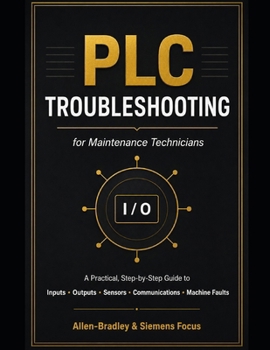
PLC Troubleshooting for Maintenance Technicians: A Practical Step-by-Step Guide to Diagnosing Inputs, Outputs, Sensors, Communications, Drives, and Ma

When a PLC-controlled machine stops, you do not need more theory-you need a clear method for finding the fault.
PLC Troubleshooting for Maintenance Technicians is a practical guide for electricians, maintenance technicians, and anyone responsible for keeping automated machinery running. It teaches you how to approach PLC-related problems systematically, even when production is waiting, documentation is incomplete, and the cause is not immediately obvious.
This is not a PLC programming textbook. Instead, it focuses on the skills maintenance technicians actually need: reading machine conditions, understanding basic ladder logic, checking inputs and outputs, using controller diagnostics, following signals through the system, and identifying the real cause of a machine fault.
Inside, you will learn how to:
- Think like a professional troubleshooter instead of guessing or replacing parts unnecessarily
- Understand the PLC scan cycle, hardware architecture, tags, addresses, and I/O mapping
- Read basic ladder logic without being a PLC programmer
- Use status LEDs, diagnostic buffers, controller fault logs, and HMI alarms
- Troubleshoot digital and analog inputs and outputs
- Diagnose proximity sensors, photoelectric sensors, limit switches, pressure devices, and other field components
- Test solenoids, contactors, motor starters, drives, and actuators
- Find Ethernet, PROFINET, EtherNet/IP, serial, and fieldbus communication problems
- Diagnose intermittent faults that disappear before maintenance arrives
- Follow a repeatable 10-step troubleshooting procedure
- Document repairs and reduce the chance of the fault returning
The book includes practical examples involving Siemens and Allen-Bradley PLC systems while emphasizing principles that apply to almost any PLC-controlled machine.
Whether you are new to industrial automation, moving from electrical maintenance into PLC troubleshooting, or looking for a more structured approach to machine breakdowns, this guide will help you troubleshoot with greater confidence, accuracy, and speed.
Stop guessing. Start measuring, testing, and narrowing the fault step by step.
Customer Reviews
ThriftBooks ® and the ThriftBooks ® logo are registered trademarks of Thrift Books Global, LLC
