


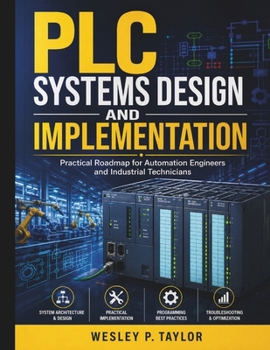
PLC Systems Design and Implementation: Practical Roadmap for Automation Engineers and Industrial Technicians

Have you ever stood in front of a control panel and wondered, "Where do I even begin to design a system that actually works in the real world?" Or maybe you've asked yourself, "Why do so many PLC projects look good on paper but fail under real industrial pressure?"
That's exactly where PLC Systems Design and Implementation: Practical Roadmap for Automation Engineers and Industrial Technicians by Wesley P. Taylor steps in-not as another dry technical manual, but as a conversation with you, the engineer, the technician, the problem-solver who wants clarity, confidence, and control.
Think about this for a moment: what if you had a guide that didn't just explain PLCs, but actually walked you through the thinking process behind designing, building, and implementing them? What if every stage-from concept to commissioning-felt structured, logical, and achievable?
This book doesn't assume you already know everything. Instead, it asks the same questions you've probably been asking:
How do I design a PLC system that is scalable and reliable?
What are the common mistakes that cost time, money, and safety?
How do I bridge the gap between theory and actual industrial application?
And then-it answers them. Clearly. Practically. Step by step.
As you move through the pages, you'll start to notice something different. This isn't just about wiring diagrams or ladder logic. It's about understanding why things are done a certain way. It's about learning how to think like a seasoned automation professional. You're not just following instructions-you're developing a mindset.
Have you ever felt overwhelmed by the complexity of integrating hardware, software, and real-world constraints? This book breaks that complexity down into manageable, logical pieces. It challenges you:
What if system design didn't have to feel chaotic?
What if implementation could be predictable instead of stressful?
You'll explore practical workflows, real-world considerations, and decision-making frameworks that make you stop and say, "Why hasn't anyone explained it like this before?"
And here's something even more important-this book respects your ambition. Whether you're just starting out or already working in industrial automation, it meets you where you are and pushes you further. It doesn't just teach you how to do the job-it prepares you to do it better than before.
Imagine walking into your next project with clarity.
Imagine designing systems that don't just function-but perform efficiently, safely, and consistently.
Imagine being the person others turn to when things get complicated.
So, ask yourself honestly:
Are you ready to move from guesswork to structured expertise?
Are you ready to design PLC systems with confidence instead of hesitation?
If the answer is yes, then this book isn't just something to read-it's something to experience.
Take the next step. Open the roadmap. Start building smarter systems today.
Customer Reviews
ThriftBooks ® and the ThriftBooks ® logo are registered trademarks of Thrift Books Global, LLC
