


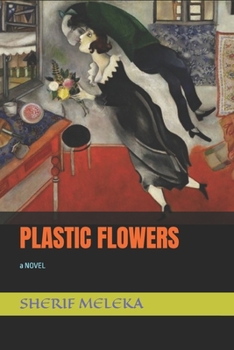
Plastic Flowers
No Customer Reviews

The novel's title encapsulates the central binary opposition that the writer persistently seeks to unravel-or at the very least, to disentangle. Flowers, the novel's overarching metaphor, symbolize nature, while plastic signifies industry. At first glance, their coexistence appears as implausible as squaring the circle or existing in two places at once. Hence, the image of flowers recurs throughout the novel as a leitmotif.
We first encounter this motif when the narrator, seated at his desk, idly runs his fingers along the rim of a teacup, now empty save for the withered brown petals settled at its bottom. Later, on the northeastern coast of the United States, he observes streets adorned with a riot of blooming flowers-buds unfurling, leaves greening, petals fluttering to carpet the ground in a vibrant mosaic of color and fragrance, heralding the arrival of a season of love and revelry.
As the novel unfolds, we learn that Sami-so he claims-is embarking on a business venture: importing plastic flowers to the island where he resides. Like all modern commercial enterprises, this endeavor requires capital, legal contracts, and monopolistic maneuvering, once again signaling the relentless encroachment of materialist values upon the natural world.
The narrator reflects on Sami's scheme: The strangeness of plastic flowers on a tropical island, lush with natural blooms long before it was even inhabited, continues to baffle me. This paradox recalls Jean-Jacques Rousseau and the Romantics of the eighteenth century, who saw civilization as the corruption of pure nature and advocated a return to the wild as a remedy for human distress. Yet material progress has long since left them behind-dreamers powerless against the inexorable march of steam engines, electricity, nuclear fission, genetic engineering, and the digital revolution.
As the narrator mourns his father's passing, he contemplates: At last, the flower has withered on its stem and fallen, disappearing from us forever. Neither its former freshness nor its fragrance could save it. It obeyed the inexorable command of time, bidding it to fade and vanish. And then they say, 'Such is life.' We laugh at their naivety-no, forgive me: such is death! A thought struck me then, startling me out of my grief. How could that flower have remained eternally fresh? If only it had been an artificial flower-plastic, perhaps-untouched by decay or death...
At its core, Plastic Flowers interrogates not only reality but also the illusions that shape our perceptions. Is the island-a secret American intelligence outpost in the Atlantic, southwest of Bermuda-a utopia, or its nightmarish inverse, a dystopia akin to Orwell's 1984? Is it even real, or merely a figment of the imagination? Meleka deliberately leaves these questions unanswered, allowing them to linger in the realm of possibility, enriching the novel's evocative power and intellectual depth.
We first encounter this motif when the narrator, seated at his desk, idly runs his fingers along the rim of a teacup, now empty save for the withered brown petals settled at its bottom. Later, on the northeastern coast of the United States, he observes streets adorned with a riot of blooming flowers-buds unfurling, leaves greening, petals fluttering to carpet the ground in a vibrant mosaic of color and fragrance, heralding the arrival of a season of love and revelry.
As the novel unfolds, we learn that Sami-so he claims-is embarking on a business venture: importing plastic flowers to the island where he resides. Like all modern commercial enterprises, this endeavor requires capital, legal contracts, and monopolistic maneuvering, once again signaling the relentless encroachment of materialist values upon the natural world.
The narrator reflects on Sami's scheme: The strangeness of plastic flowers on a tropical island, lush with natural blooms long before it was even inhabited, continues to baffle me. This paradox recalls Jean-Jacques Rousseau and the Romantics of the eighteenth century, who saw civilization as the corruption of pure nature and advocated a return to the wild as a remedy for human distress. Yet material progress has long since left them behind-dreamers powerless against the inexorable march of steam engines, electricity, nuclear fission, genetic engineering, and the digital revolution.
As the narrator mourns his father's passing, he contemplates: At last, the flower has withered on its stem and fallen, disappearing from us forever. Neither its former freshness nor its fragrance could save it. It obeyed the inexorable command of time, bidding it to fade and vanish. And then they say, 'Such is life.' We laugh at their naivety-no, forgive me: such is death! A thought struck me then, startling me out of my grief. How could that flower have remained eternally fresh? If only it had been an artificial flower-plastic, perhaps-untouched by decay or death...
At its core, Plastic Flowers interrogates not only reality but also the illusions that shape our perceptions. Is the island-a secret American intelligence outpost in the Atlantic, southwest of Bermuda-a utopia, or its nightmarish inverse, a dystopia akin to Orwell's 1984? Is it even real, or merely a figment of the imagination? Meleka deliberately leaves these questions unanswered, allowing them to linger in the realm of possibility, enriching the novel's evocative power and intellectual depth.
Format:Paperback
Language:English
ISBN:B0F53H898X
ISBN13:9798280058132
Release Date:April 2025
Publisher:Independently Published
Length:210 Pages
Weight:0.63 lbs.
Dimensions:0.5" x 6.0" x 9.0"
Customer Reviews
0 rating
Copyright © 2026 Thriftbooks.com Terms of Use
| Privacy Policy | Do Not
Sell/Share My Personal Information | Cookie Policy | Cookie Preferences | Accessibility Statement
ThriftBooks® and the ThriftBooks® logo are registered trademarks of Thrift Books Global, LLC
ThriftBooks® and the ThriftBooks® logo are registered trademarks of Thrift Books Global, LLC
