


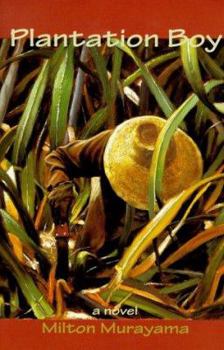
Plantation Boy

Select Format
Select Condition 
Book Overview
No other writer has attempted such a broad view of the nisei experience in Hawai'i as Milton Murayama. In Plantation Boy, the third novel in a planned tetralogy that includes the highly popular All I Asking for Is My Body and Five Years on a Rock, eldest son Toshio narrates the continuing story of the Oyama family. Outspoken, proud, determined, passionate: Tosh is the voice of the rebel that authority seeks to silence; he is the proverbial "protruding nail" that Japanese tradition seeks to flatten. His fight is against not only his family's poverty and the environment that keeps them oppressed, but also his own plantation-boy mentality. His struggles are set against the cataclysmic events of World War II--the bombing of Pearl Harbor, the internment of Japanese Americans, the heroism of the 100th and 442nd in Europe, the atrocities committed by the Japanese army in Asia--and the social and political upheavals in Hawai'i. Here is a powerful work about Japanese in Hawai'i that shows us more than stereotypes. By illuminating Tosh's life, Murayama evokes a family and a community and, brilliantly, a critical vision of culture, of language, and of history itself.
Format:Paperback
Language:English
ISBN:082482007X
ISBN13:9780824820077
Release Date:January 1998
Publisher:University of Hawaii Press
Length:192 Pages
Weight:0.65 lbs.
Dimensions:9.3" x 0.5" x 6.3"
Related Subjects
Contemporary Domestic Life Fiction Genre Fiction Historical Literature & Fiction Women's FictionCustomer Reviews
1 rating
A scrapper's story continues
Published by Thriftbooks.com User , 16 years ago
Toshio Oyama is the "Plantation Boy," and he hates it. This is the third of a projected four novels by Milton Murayama about the Oyama family of Kahana, Maui. It carries eldest son Tosh into the 1960s, battling all the way, hardheaded, angry and stiffnecked. We first met the Oyamas in "All I Asking for is My Body," the first novel to use pidgen in a natural way. Murayama is acknowledged by other writers as the man who opened the gates for a local literature of Hawaii. In his first novel, Murayama made no compromises. The pidgen words, the Japanese phrases were left unexplained. If you didn't know what they meant, you could still follow the story. If you knew, the story was richer. Like Tosh, Murayama appears to have softened a little -- a very little. There is still plenty of pidgen -- real pidgen, not the slangy American that current usage is rapidly evolving toward -- plus phrases in Japanese, both kanji and katakana. Most are unexplained, but either because it is important to the development of the characters or because Murayama is relenting a little, some are elucidated. By giving Tosh a wife, Carol, who is better educated, Murayama is able to have her explain to him (and to English-only readers like me) a pun a Japanese. And a central image throughout is Tosh's correction of his friends, who call Hawaii Japanese "Buddhaheads," contrasted to Mainland Japanese "kotonks." Not Buddhaheads, Tosh repeatedly tells his drinking buddies, it has nothing to do with religion. Bulaheads, from bobora, Japanese for yokel. It may seem a little thing, but these details define Murayama's style, which is extremely compressed. Family sagas in other hands tend to run 500 pages per volume. Murayama's lapidary efforts are fewer than 200 pages. Yet they contain as much story. Tosh reflects on this when he compares his rapid-fire, compact pidgen repartee with the slow speech of a haole (white) co-worker. He decides the haole talks slow because he thinks slow. But to scrabble off the plantation, you have to have your wits about you. Boxing (as we learned in "All I Asking") was his first choice out, and it took quick wits to succeed. By the time of "Plantation Boy," boxing is no longer an option. Tosh is on the way to becoming Steve Oyama, A.I.A. It's good story. To Maui readers, either born-and-raised or malihini, it has extra zest. Real Maui people appear, like Tosh Ansai, a well-remembered politician. And also Maui men who have been forgotten by all except family and friends: the men killed in World War II. As Tosh relates his activities during the war, he talks about the jeep that brought the bad news. The names of the casualties are real: Albert Neizman, killed in the Gilbert Islands; Kosei Nakamura, killed in Italy; Warren Prescott, killed in France. Murayama's novels have a sense of immediacy. The real names contribute to that. A nearly complete absence of abstract adjectives contributes as well. Life was dog-eat-dog in Kahana and "Pepelau
Copyright © 2026 Thriftbooks.com Terms of Use
| Privacy Policy | Do Not
Sell/Share My Personal Information | Cookie Policy | Cookie Preferences | Accessibility Statement
ThriftBooks® and the ThriftBooks® logo are registered trademarks of Thrift Books Global, LLC
ThriftBooks® and the ThriftBooks® logo are registered trademarks of Thrift Books Global, LLC
