


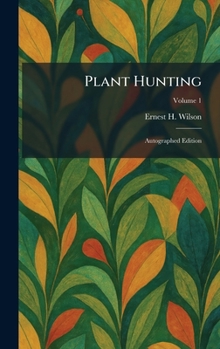
Plant Hunting: Autographed Edition

"Plant Hunting" is a compelling and authoritative account of botanical exploration by the legendary plant collector Ernest H. Wilson. In this first volume, Wilson recounts his extensive travels through diverse landscapes, documenting the discovery of countless plant species that have since become staples in gardens across the globe. Part travelogue and part scientific record, the work offers a vivid look into the challenges and triumphs of early twentieth-century expeditions into the heart of Africa, Australia, and other remote regions.
Wilson's narrative is more than a simple list of flora; it is a testament to the adventurous spirit of botanical science. He provides detailed observations of the habitats, growth patterns, and unique characteristics of the plants he encountered, from towering forest giants to delicate mountain blossoms. For gardening enthusiasts, botanists, and historians, "Plant Hunting" serves as an essential bridge between the natural world and the cultivated gardens of the West. Through Wilson's expert eyes, readers gain insight into the arduous process of plant introduction and the enduring impact these discoveries had on horticulture and biodiversity. This work remains a classic in the field, celebrating the beauty of the natural world and the dedication of those who sought to share its wonders with the world.
This work has been selected by scholars as being culturally important, and is part of the knowledge base of civilization as we know it. This work was reproduced from the original artifact, and remains as true to the original work as possible. Therefore, you may see the original copyright references, library stamps (as most of these works have been housed in our most important libraries around the world), and other notations in the work.
This work is in the public domain in the United States of America, and possibly other nations. Within the United States, you may freely copy and distribute this work, as no entity (individual or corporate) has a copyright on the body of the work.
As a reproduction of a historical artifact, this work may contain missing or blurred pages, poor pictures, errant marks, etc. Scholars believe, and we concur, that this work is important enough to be preserved, reproduced, and made generally available to the public. We appreciate your support of the preservation process, and thank you for being an important part of keeping this knowledge alive and relevant.
Customer Reviews
ThriftBooks ® and the ThriftBooks ® logo are registered trademarks of Thrift Books Global, LLC
