


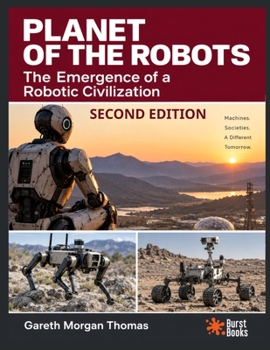
Planet of the Robots: The Emergence of a Robotic Civilization

A robot that builds a factory is impressive. A robotic society that keeps it running could change civilization.
Who supplies its energy? Who repairs its machines? Who decides what it produces-and what happens when those decisions conflict with human needs?
Follow those questions far enough and you reach a future much bigger than driverless cars and humanoid assistants.
You reach Planet of the Robots: The Emergence of a Robotic Civilization.
Gareth Morgan Thomas takes you inside the systems that could allow autonomous machines to work together, maintain infrastructure, organize production and establish industrial outposts beyond Earth.
The crucial transition begins when machines can sustain the productive network they depend on. Understanding that transition changes how you evaluate everything from a robot demonstration to a proposal for a settlement on another planet.
Inside, you'll discover:
- What separates a collection of robots from a functioning society. Explore the coordination, shared knowledge and resource systems that turn individual capabilities into collective power.
- Why the machines that transform civilization may look nothing like us. Understand where humanoids fit-and why specialized robots could carry much of the industrial workload.
- The hidden dependencies behind claims of autonomy. A machine may navigate independently while relying on people for power, spare parts and repair. Learn what greater self-sufficiency actually requires.
- How cooperation can break down. Examine task allocation, competition, consensus, security and recovery when machines must share a physical world.
- What it would take to build and maintain robot cities. Connect intelligent decision-making with the demands of energy, transport, manufacturing and infrastructure.
- Who holds authority when machines make consequential decisions. Investigate governance, accountability, human identity and the implications of increasingly advanced AI.
- How robotic industry could expand across the Solar System. Explore the production, maintenance and supply challenges that stand between a visiting rover and an enduring outpost.
Go beyond watching the demonstrations. Understand what must happen next.
Across 20 chapters, supported by technical appendices, analytical frameworks and a glossary, this book brings engineering and social questions into the same field of view.
You'll gain a way to interrogate ambitious claims: What can the system sustain? What does it still need from outside? How does it recover from failure? Who sets its objectives?
Written for engineers, students and technically curious readers, Planet of the Robots gives you the foundations to think seriously about a world increasingly built and maintained by autonomous machines.
Get your copy and explore what it would take for robotic civilization to become a working reality.
Customer Reviews
ThriftBooks ® and the ThriftBooks ® logo are registered trademarks of Thrift Books Global, LLC
