


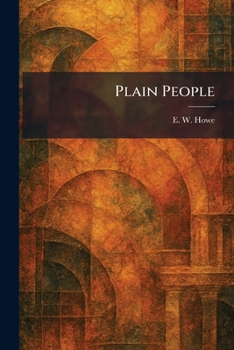
Plain People

Select Format
Select Condition 
Book Overview
"Plain People" is the evocative autobiography of E. W. Howe, a towering figure in American journalism and letters often referred to as the "Sage of Potato Hill." In this candid and insightful memoir, Howe chronicles his life from his early days on the Kansas frontier to his influential career as the editor and proprietor of the Atchison Globe. The narrative serves as a vivid portrait of the American Midwest during a period of profound transformation, capturing the spirit, struggles, and idiosyncrasies of the everyday citizens who shaped the heartland.
Throughout the work, Howe provides a behind-the-scenes look at the world of nineteenth and early twentieth-century newspaper publishing, blending his sharp wit with a realist's perspective on human nature. He reflects on the social fabric of small-town communities, offering observations that are both deeply personal and broadly reflective of the era's cultural landscape. "Plain People" stands as a significant historical document and a literary achievement, providing readers with an authentic voice from the American West. It remains an essential read for those interested in the history of American journalism, Midwestern heritage, and the life of one of the country's most unique editorial voices.
This work has been selected by scholars as being culturally important, and is part of the knowledge base of civilization as we know it. This work was reproduced from the original artifact, and remains as true to the original work as possible. Therefore, you may see the original copyright references, library stamps (as most of these works have been housed in our most important libraries around the world), and other notations in the work.
This work is in the public domain in the United States of America, and possibly other nations. Within the United States, you may freely copy and distribute this work, as no entity (individual or corporate) has a copyright on the body of the work.
As a reproduction of a historical artifact, this work may contain missing or blurred pages, poor pictures, errant marks, etc. Scholars believe, and we concur, that this work is important enough to be preserved, reproduced, and made generally available to the public. We appreciate your support of the preservation process, and thank you for being an important part of keeping this knowledge alive and relevant.
Customer Reviews
ThriftBooks® and the ThriftBooks® logo are registered trademarks of Thrift Books Global, LLC
