


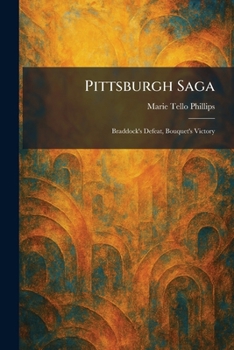
Pittsburgh Saga: Braddock's Defeat, Bouquet's Victory

"Pittsburgh Saga: Braddock's Defeat, Bouquet's Victory 1748-1764" is a compelling historical narrative that chronicles the pivotal years of the French and Indian War on the Pennsylvania frontier. Marie Tello Phillips provides a detailed account of the struggle for control over the strategic "Point" where the Allegheny and Monongahela rivers meet to form the Ohio. The work traces the dramatic shifts in fortune from the catastrophic defeat of General Edward Braddock's forces in 1755 to the eventual British ascendancy secured by Colonel Henry Bouquet.
Through a blend of military history and regional analysis, the book explores the complex dynamics between European powers, colonial settlers, and Indigenous populations during a formative era of American history. Readers will find a vivid depiction of life in the wilderness, the construction of Fort Pitt, and the early development of the region that would become the industrial heart of Pittsburgh. This saga serves as an essential resource for those interested in colonial military strategy, the Seven Years' War, and the foundational history of Western Pennsylvania. Phillips captures the tension and triumph of the era, emphasizing the historical significance of these events in shaping the future of the American colonies.
This work has been selected by scholars as being culturally important, and is part of the knowledge base of civilization as we know it. This work was reproduced from the original artifact, and remains as true to the original work as possible. Therefore, you may see the original copyright references, library stamps (as most of these works have been housed in our most important libraries around the world), and other notations in the work.
This work is in the public domain in the United States of America, and possibly other nations. Within the United States, you may freely copy and distribute this work, as no entity (individual or corporate) has a copyright on the body of the work.
As a reproduction of a historical artifact, this work may contain missing or blurred pages, poor pictures, errant marks, etc. Scholars believe, and we concur, that this work is important enough to be preserved, reproduced, and made generally available to the public. We appreciate your support of the preservation process, and thank you for being an important part of keeping this knowledge alive and relevant.
Related Subjects
HistoryCustomer Reviews
ThriftBooks ® and the ThriftBooks ® logo are registered trademarks of Thrift Books Global, LLC
