


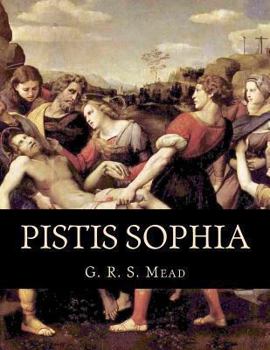
Pistis Sophia


Select Format
Select Condition 
Book Overview
Pistis Sophia is an important Gnostic text, possibly written as early as the 2nd century. The five remaining copies, which scholars place in the 5th or 6th centuries, relate the Gnostic teachings of the transfigured Jesus to the assembled disciples (including his mother Mary, Mary Magdalene, and Martha), when the risen Christ had accomplished eleven years speaking with his disciples. In it the complex structures and hierarchies of heaven familiar in Gnostic teachings are revealed. The female divinity of gnosticism is Sophia, a being with many aspects and names. She is sometimes identified with the Holy Spirit itself but, according to her various capacities, is also the Universal Mother, the Mother of the Living or Resplendent Mother, the Power on High, She-of-the-left-hand (as opposed to Christ, understood as her husband and he of the Right Hand), as the Luxurious One, the Womb, the Virgin, the Wife of the Male, the Revealer of Perfect Mysteries, the Holy Dove of the Spirit, the Heavenly Mother, the Wandering One, or Elena (that is, Selene, the Moon). She was envisaged as the Psyche of the world and the female aspect of Logos. The title Pistis Sophia is obscure, and is sometimes translated Faith wisdom or Wisdom in faith or Faith in wisdom. A more accurate translation taking into account its gnostic context, is the faith of Sophia, as Sophia to the gnostics was a divine syzygy of Christ, rather than simply a word meaning wisdom. In an earlier, simpler version of a Sophia, in the Berlin Codex and also found in a papyrus at Nag Hammadi, the transfigured Christ explains Pistis in a rather obscure manner: Again, his disciples said: Tell us clearly how they came down from the invisibilities, from the immortal to the world that dies? The perfect Saviour said: Son of Man consented with Sophia, his consort, and revealed a great androgynous light. Its male name is designated 'Saviour, begetter of all things'. Its female name is designated 'All-begettress Sophia'. Some call her 'Pistis'. The best-known of the five manuscripts of Pistis Sophia is bound with another Gnostic text titled on the binding "Piste Sophiea Cotice". This "Askew Codex" was purchased by the British Museum (now British Library) in 1795 from a Dr. Anthony Askew. Until the discovery of the Nag Hammadi library in 1945, the Askew Codex was one of three codices that contained almost all of the gnostic writings that had survived the suppression of such literature both in East and West, the other two codices being the Bruce Codex and the Berlin Codex. Aside from these primary sources, everything written about Gnosticism before the Nag Hammadi library became available is based on quotes, characterizations, and caricatures in the writings of the enemies of Gnosticism. The purpose of these heresiological writings were polemical, presenting Gnostic teachings as absurd, bizarre, and self-serving, and as an aberrant heresy from a proto-orthodox and orthodox Christian standpoint. The text proclaims that Jesus remained on earth after the resurrection for 11 years, and was able in this time to teach his disciples up to the first (i.e. beginner) level of the mystery. It starts with an allegory paralleling the death and resurrection of Jesus, and describing the descent and ascent of the soul. After that it proceeds to describe important figures within the gnostic cosmology, and then finally lists 32 carnal desires to overcome before salvation is possible, overcoming all 32 constituting salvation. Pistis Sophia includes quotes from five of the Odes of Solomon, found in chapters between 58 and 71. Pistis Sophia was the only known source for the actual wording of any of the Odes until the discovery of a nearly-complete Syriac text of the Odes in 1909. Because the first part of this text is missing, Pistis Sophia is still the only source for Ode 1.
Format:Paperback
Language:English
ISBN:1463644647
ISBN13:9781463644642
Release Date:June 2011
Publisher:Createspace Independent Publishing Platform
Length:238 Pages
Weight:1.55 lbs.
Dimensions:0.5" x 8.5" x 11.0"
Customer Reviews
4 ratings
Pistis Sophia
Published by Thriftbooks.com User , 17 years ago
I love this book, every time you reread the text you will discover a new truth, Jesus, Mary Magdalene, and Peter are compelling in their discourses. The Magdalene proves her superiority as to understanding Jesus'words, compared to the knowledge and understanding of the male diciples. It is easy to see why "He loved her best". It is best to have a basic understanding of Gnosticism to receive the most from the "first read". You will want to read it again and again.
"Pistis Sophia" a Masterpiece of Gnosis
Published by Thriftbooks.com User , 18 years ago
All true seekers of Gnosis should study this remarkable book, illuminating masterpiece showing part of the pre-advent and post-resurrectional work and transcendent teachings of Lord Jesus.
"extraordinaire"
Published by Thriftbooks.com User , 26 years ago
Ignore the 5 stars and put 6 stars instead! I am still wandering why it took such a long time for me to review this extraordinary gospel. This is one of the most easy to read and follow gospel within the Gnostic gospels, and indeed amongst many of the gospels. The language is clear and the gospel is well structured. Pistis is indeed a rare gospel: it tells of the secret words that you must say for you to reach the highest God and Goddess (not the God of creation); it informs you of the many gods and goddesses that exist and the levels of space they occupy. Mind you, all these is said by Jesus himself, that is the Gnostic Jesus. Mary Magdala (Jesus' partner) is so intelligent in her questions and answers, in fact Jesus tells her that her spirit has been purified and therefore at its best (of course hoping that this is a genuine praise and not based on partner favouritism). But yes, Mary Magadala, beside the praises from her partner, is quite outstanding. She even tells Jesus that she is scared of Peter since St Peter hates the female race! Do not expect anything canonical or convetional from this gospel. It is a very disturbing gospel, yet very powerful indeed. It even explains the difficult parables: "5 will be in a house and 3 will rise against 2 and 2 against 3..." It also explains the parable of the coin - give to Caesar that which belongs to him... This is one gospel, which I must concur, I also do not understand why it has not received much attention as the other gospels!
A great introduction to Christian Gnostic Universe
Published by Thriftbooks.com User , 26 years ago
Although considered a minor Gnostic text by some scholars of Gnosticism, this document provides an excellent introduction to the universe of a Christian Gnostic of the time of Christ. After reading this I would suggest to go on to "Nag Hammadi" and "The Apocryphal New Testament : A Collection of Apocryphal Christian Literature in an English Translation."
Copyright © 2026 Thriftbooks.com
Terms of Use | Privacy Policy | Do Not Sell/Share My Personal Information | Cookie Notice | Cookie Preferences | Accessibility Statement
ThriftBooks ® and the ThriftBooks ® logo are registered trademarks of Thrift Books Global, LLC
ThriftBooks ® and the ThriftBooks ® logo are registered trademarks of Thrift Books Global, LLC
