


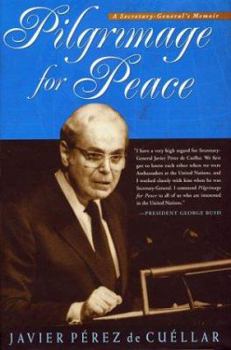
Pilgrimage For Peace: A Secretary General's Memoir

Javier Perez de Cuellar served as the Secretary General of the United Nations from 1982-1991, a period in which some of the most dramatic and politically significant events of the late 20th century... This description may be from another edition of this product.
Format:Hardcover
Language:English
ISBN:0312164866
ISBN13:9780312164867
Release Date:August 1997
Publisher:Palgrave Macmillan
Length:544 Pages
Weight:2.10 lbs.
Dimensions:10.0" x 1.8" x 6.5"
Customer Reviews
1 rating
in International Relations...
Published by Thriftbooks.com User , 25 years ago
Reviewed in International Relations Vol14 No4 April 1999 byPETER UNWIN...To be Secretary-General of the United Nations must bethe world's most impossible job. He must take a view on all theworld's problems, and action on many of them. He leads anunderfunded organization and a staff notoriously uneven in itsabilities and commitment. In everything he undertakes he has toprotect his objectivity, remembering the disparate interests of theglobal constituency he serves. And day-in-day-out the world demandsof him solutions to the insoluble, all too often undercuts hisefforts, and blames him for his failures.To produce a readablememoir of a Secretary-General's experiences must be literature'smost impossible task. The tasks he faces are by their very natureepisodic, eclectic, disparate, tackling first this challenge to theworld's well-being and then that. And that vast majority of readerswho still locate themselves first by reference to the country fromwhich they come, look for a national focus which a conscientiousSecretary-General must eschew.This is a background against whichJavier Perez de Cuellar has produced Pilgrimage for Peace, an accountof his stewardship in tackling fifteen of the multitude of issues withwhich he was involved as Secretary-General between 1982 and 1991. Theyrange from Lebanon to Central America, Cambodia to Yugoslavia, takingin things like Cyprus, Namibia and the Western Sahara along theway. There is something here for everyone, but the episodes which arelikely to interest a predominantly British-based readership areperhaps his accounts of the Falklands crisis and of the War in theGulf.In describing his attempts to find a peaceful resolution tothe Falklands dispute, Perez de Cuellar confronts very frankly his ownLatin American background. His account of his negotiations withBritish and Argentine representatives seems scrupulously fair, whilediscreetly admitting to finding the British approach the morepersuasive of the two. Here, as in so many of his case histories, hesees time as the enemy, with the unstoppable march of events forcingdeadlines and ultimata upon the negotiators. So for him, AlexanderHaig's attempts at shuttle diplomacy are valiant and ingenious butin the end extravagant of the time that was ticking away as theBritish task force advanced into the South Atlantic and Londonconvinced itself that Buenos Aires was playing not for a solution butfor time. For the statesman in such a case, Perez de Cuellar comments,time may in the long run prove itself a healer, but in the press ofevents it is a tyrannical master.In his treatment of the Gulf Wareight years later, Perez de Cuellar examines a very different crisis,and looks at it from the point of view of the interaction between twopeacemaking forces which at their best are mutually supportive but caneasily get at odds with one another. The one is action by a state or agroup of states, in the case of the Gulf the coalition which GeorgeBush put together in support of a predo
Copyright © 2026 Thriftbooks.com Terms of Use
| Privacy Policy | Do Not
Sell/Share My Personal Information | Cookie Policy | Cookie Preferences | Accessibility Statement
ThriftBooks® and the ThriftBooks® logo are registered trademarks of Thrift Books Global, LLC
ThriftBooks® and the ThriftBooks® logo are registered trademarks of Thrift Books Global, LLC
