


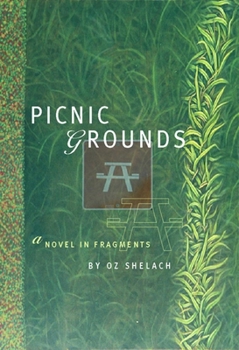
Picnic Grounds: A Novel in Fragments


Select Format
Select Condition 
Book Overview
Spare and haunting, whimsical and contemplative snapshot-stories that reveal an unfamiliar Israel by remapping its blind spots.
Format:Paperback
Language:English
ISBN:0872864197
ISBN13:9780872864191
Release Date:April 2003
Publisher:City Lights Books
Length:112 Pages
Weight:0.60 lbs.
Dimensions:0.4" x 4.4" x 6.8"
Customer Reviews
4 ratings
Always out of context
Published by Thriftbooks.com User , 21 years ago
I have noticed that most reviewers have seen this book through their own eyes, well informed, educated eyes and how could they do anything else? Right? Except that the book must exist outside of history. Sure you could argue that by saying where in the holy city he was born, he was declaring a political agenda but there will come a time in history when no one will know what that means to be born on the west side and then they must decide for themselves the value of the book. They must see the subtle shifts in mood, the creeping fear that the narrator is loosing identity, that who we are is not always who we really are and how this world is sometimes not this world. I know how cryptic that must sound but if you read the book and divorce yourself, as must as possible from the politics, the book will come alive the way Van Gogt comes alive when you see past the print on your wall to the thick, confused paint strokes on real canvas. Read Picnic Grounds. It's very inexpensive and it won't break the bank. Read it at least once.
Shaking up Hallowed Ground
Published by Thriftbooks.com User , 22 years ago
To many, the year 1948 represents the establishment of the modern state of Israel; to others, 1948 is inextricably intertwined with Al-Nakba, or the Catastrophe; the destruction of indigenous Palestinian communities and the creation of a diaspora of downtrodden refugees. It is not difficult to ascertain where former Israeli journalist Oz Shelach's sympathies lie. The short author bio, at the back of Picnic Grounds: A Novel In Fragments, states that the author was born not in Jerusalem but in "West" Jerusalem; an overt political statement, incendiary to those who support Israeli sovereignty over all of the holy city.Picnic Grounds is a relentlessly political book in which the Jerusalem neighborhoods of Katamon and Talbieh as well as the Jezreel Valley are all spelled with their Arabic transliterations. The author has even chosen to write the book in English, either to reach a larger readership, or perhaps to cast off the language of the putative oppressor.It is difficult to call Picnic Grounds a novel; composed of fifty-seven fragments each no longer than two pages, the book is a series of minor epiphanies, the best of which are reminiscent of the poetic compression of Ernest Hemingway's vignettes in "In Our Time." The book opens with a professor and his family obliviously picnicking in the woods at the sight of Deir Yassin, a former Arab village where scores of its inhabitants were massacred by Irgun irregulars in April of 1948. The story is subtle and chilling, and sets the tone for the entire book. Shelach returns again and again to picnic grounds throughout Israel where "a village was bombed out and later razed," or "ghosts... haunt the soil which is soaked with blood." But, there is little that is shrill or strident in Shelach's writing, he allows silences to speak volumes; the whispering of tall Canadian pine trees on the road from Tel Aviv to Jerusalem serves as a mute testament to depopulated Arab villages. This is an angry book, but its cool, dispassionate tone, sly wit and humor is usually deft enough to diffuse heavy-handedness.Much of the book is written in a collective first person "we," voice and the reader travels from the fortresslike Hebrew University throughout Israel to the Sinai Desert -- a land, "we had once called ours." And throughout the narrator's travels, disillusionment abounds; the natural beauty of the Land, its Za'atar fields, wildflowers and olive groves corrupted by colonizing militias. The reader witnesses the aftermath of suicide bombings, the controversial trial of suspected Nazi war criminal John Demjanjuk, a war widow on vacation in Kathmandu, discovering that Baruch Goldstein has massacred dozens of Muslims at prayer in a Hebron mosque. And in a clever subversion of the heavy burden of history that the Israelis must bear, the narrator encounters an old friend from high school dressed in traditional Arab garb, working at the Museum of Bedouin Heritage. When asked what he is doing there, the friend answer
A powerful, disturbing book
Published by Thriftbooks.com User , 22 years ago
To many, the year 1948 represents the establishment of the modern state of Israel; to others, 1948 is inextricably intertwined with Al-Nakba, or the Catastrophe; the destruction of indigenous Palestinian communities and the creation of a diaspora of downtrodden refugees. It is not difficult to ascertain where former Israeli journalist Oz Shelach's sympathies lie. The short author bio, at the back of Picnic Grounds: A Novel In Fragments, states that the author was born not in Jerusalem but in "West" Jerusalem; an overt political statement, incendiary to those who support Israeli sovereignty over all of the holy city. Picnic Grounds is a relentlessly political book in which the Jerusalem neighborhoods of Katamon and Talbieh as well as the Jezreel Valley are all spelled with their Arabic transliterations. The author has even chosen to write the book in English, either to reach a larger readership, or perhaps to cast off the language of the putative oppressor. It is difficult to call Picnic Grounds a novel; composed of fifty-seven fragments each no longer than two pages, the book is a series of minor epiphanies, the best of which are reminiscent of the poetic compression of Ernest Hemingway's vignettes in "In Our Time." The book opens with a professor and his family obliviously picnicking in the woods at the sight of Deir Yassin, a former Arab village where scores of its inhabitants were massacred by Irgun irregulars in April of 1948. The story is subtle and chilling, and sets the tone for the entire book. Shelach returns again and again to picnic grounds throughout Israel where "a village was bombed out and later razed," or "ghosts... haunt the soil which is soaked with blood." But, there is little that is shrill or strident in Shelach's writing, he allows silences to speak volumes; the whispering of tall Canadian pine trees on the road from Tel Aviv to Jerusalem serves as a mute testament to depopulated Arab villages. This is an angry book, but its cool, dispassionate tone, sly wit and humor is usually deft enough to diffuse heavy-handedness.Much of the book is written in a collective first person "we," voice and the reader travels from the fortresslike Hebrew University throughout Israel to the Sinai Desert -- a land, "we had once called ours." And throughout the narrator's travels, disillusionment abounds; the natural beauty of the Land, its Za'atar fields, wildflowers and olive groves corrupted by colonizing militias. The reader witnesses the aftermath of suicide bombings, the controversial trial of suspected Nazi war criminal John Demjanjuk, a war widow on vacation in Kathmandu, discovering that Baruch Goldstein has massacred dozens of Muslims at prayer in a Hebron mosque. And in a clever subversion of the heavy burden of history that the Israelis must bear, the narrator encounters an old friend from high school dressed in traditional Arab garb, working at the Museum of Bedouin Heritage. When asked what he is doing there, the friend an
A Moving Message in Bite Sized Pieces
Published by Thriftbooks.com User , 22 years ago
In his book, Picnic Gounds, author Oz Shelach manages to evoke a strong feeling of the history of the lands where the modern state of Israel now exists. His stories are tiny, most a single page - never more than two - and at first they seem almost unrelated. They are snippets, snapshots of modern life in Israel that the author, who was raised in Jerusalem, tells with striking clarity. For anyone who has visited modern Israel, especially Jerusalem, the places in the story will seem at first familiar, but something deeper is being evoked. Reading through the book, one soon begins to see the underlying theme of the places and the people that lived there before. The stories take place in modern Israel, but reflect back on the Palestinians who were displaced, the villages that were bulldozed, the hillsides that were razed, and the history that remains largely ignored. Through these stories, a picture of a modern state superimposed over the historical Palestine emerges. Furthermore, we begin to sense how modern Israel avoids this recent history, covers it over. A family picnic on the grounds of a former Palestinian village, or the dense pine forests covering the hillsides outside Jerusalem that once were covered with olive orchards - the stories all speak to the way modern Israel manages to exist in a state of near denial. Without pretension or moral overtones, the author gets his message across with subtle calm. The stories are very short, but like a good chocolate, they leave a lingering taste on the palette. I found myself reading only one or two stories at a time, letting their meaning sink in, and coming back to savor the morsels day after day until, sadly, the book was finished.
Copyright © 2026 Thriftbooks.com Terms of Use
| Privacy Policy | Do Not
Sell/Share My Personal Information | Cookie Policy | Cookie Preferences | Accessibility Statement
ThriftBooks® and the ThriftBooks® logo are registered trademarks of Thrift Books Global, LLC
ThriftBooks® and the ThriftBooks® logo are registered trademarks of Thrift Books Global, LLC
