


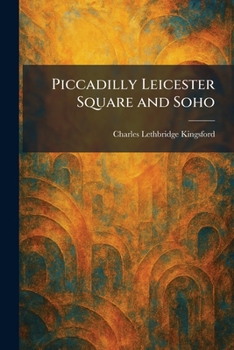
Piccadilly Leicester Square and Soho

"Piccadilly Leicester Square and Soho" offers a detailed historical and topographical exploration of one of London's most vibrant and storied districts. Written by the renowned historian Charles Lethbridge Kingsford, this work meticulously traces the evolution of the West End from its rural origins to its status as a central hub of metropolitan life. Through scholarly research and engaging narrative, the book examines the architectural transformations, social shifts, and the notable figures who shaped the character of these iconic neighborhoods.
From the grand estates of Piccadilly to the cultural melting pot of Soho and the entertainment legacy of Leicester Square, Kingsford provides a comprehensive account of the area's development. This work remains an essential resource for those interested in the history of London, urban geography, and the social fabric of the city. It highlights the enduring significance of these locations as centers of commerce, culture, and residence, capturing the historical essence of London's urban expansion and the layers of history embedded in its streets.
This work has been selected by scholars as being culturally important, and is part of the knowledge base of civilization as we know it. This work was reproduced from the original artifact, and remains as true to the original work as possible. Therefore, you may see the original copyright references, library stamps (as most of these works have been housed in our most important libraries around the world), and other notations in the work.
This work is in the public domain in the United States of America, and possibly other nations. Within the United States, you may freely copy and distribute this work, as no entity (individual or corporate) has a copyright on the body of the work.
As a reproduction of a historical artifact, this work may contain missing or blurred pages, poor pictures, errant marks, etc. Scholars believe, and we concur, that this work is important enough to be preserved, reproduced, and made generally available to the public. We appreciate your support of the preservation process, and thank you for being an important part of keeping this knowledge alive and relevant.
Customer Reviews
ThriftBooks ® and the ThriftBooks ® logo are registered trademarks of Thrift Books Global, LLC
